 J1coding
dac184c894
J1coding
dac184c894
Boot crash on iOS 18 under LiveContainer (Legacy W^X mode): CPU thread,
EXC_BAD_ACCESS KERN_PROTECTION_FAILURE in Arm64BaseBlocks::New -- a str of
a branch encoding into an r-x page. In Legacy mode armStartBlock flips
only the current block's 1 MiB window to RW, but New()'s link-repoint
loop, Remove()'s entry stubs and the backedge patch write into EARLIER
blocks, whose windows are execute-protected by then. PatchWord trusted
its callers to hold a Begin/EndCodeWrite scope; no caller on those paths
did. The toggle modes (macOS, Simulator) masked it because the compile
thread's write-protect is off arena-wide during recRecompile.

Give the patch primitive its own scope instead: armPatchCodeWord stores
through the dual-map alias and, when the target page is outside the open
emit window, wraps the store in a page-granular Begin/EndCodeWriteRange.
The page check matters -- the bump allocator routinely puts the previous
block's link site on the same page as the current block's start, and
RX-flipping that page mid-emit would kill the compile in a new way.

The whole-arena Begin/EndCodeWrite scopes that only existed to cover
those patches are gone with it. They were their own crash: Legacy range
windows bypass the refcount, so recClear's paired EndCodeWrite RX-flipped
the open emit window whenever the stale-overlap walk cleared blocks
mid-compile, and recClearIOP paid a whole-arena mprotect pair per covered
IOP store. The fastmem backpatch and the cold-island patches route
through armPatchCodeWord for the same reason, and microVU's code-cache
scope narrows to its own buffer span so an MTVU close can no longer
RX-flip an EE emit window open on the other thread.
ARMSX2 — Native ARM64 JIT Fork of PCSX2

ARMSX2 is a free and open-source PlayStation 2 (PS2) emulator based on PCSX2. Its purpose is to emulate the PS2's hardware, using a combination of MIPS CPU Interpreters, Recompilers and a Virtual Machine which manages hardware states and PS2 system memory. This allows you to play PS2 games on your phone, PC, or gaming handheld, with many additional features and benefits.
Thank You
The ARMSX2 team is eternally indebted to the PCSX2 project it is based on. We are so fortunate to build on their 20 years of hardcore development.
About This Fork
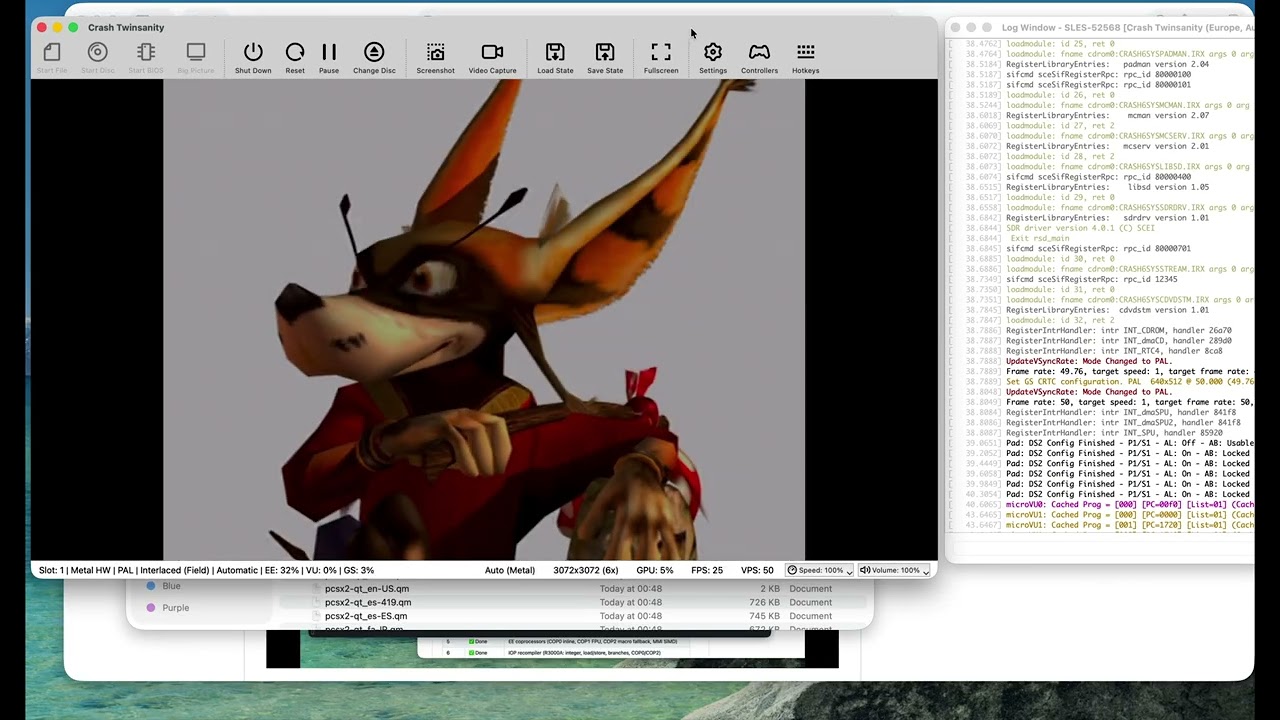
The upstream PCSX2 project ships an ARM64 interpreter build for ARM, but its high-performance JIT recompilers (EE, IOP, VU0, VU1, and vtlb fast memory) are x86-64 only.
This fork exists to close that gap. The goal is to preserve the correctness features of 20 years of PCSX2 development, while generating the fastest native ARM performance possible.
Current status:
- ✅ EE (Emotion Engine) recompiler — integer, float, MMI, COP0/COP1/COP2, branches, load/store
- ✅ IOP (I/O Processor / R3000A) recompiler — full integer, load/store, branches, coprocessors
- ✅ VU (Vector Unit) recompiler — microVU skeleton + Upper FMAC vector ISA complete; Lower ISA and runtime complete
- ✅ vtlb fast memory
- ✅ Native ARM64 binary builds and boots the PS2 BIOS
- ✅ 2D games are already playable
- ✅ 3D games run
Why LLMs / AI Were Used
A word on methodology:
The x86-64 JIT code in upstream ARMSX2 is already proven correct — it has run thousands of PS2 titles for years. The challenge in this port is not emulator design or JIT theory; it is mechanical translation of a large, well-understood x86-64 assembly codebase into equivalent ARM64 assembly (via VIXL) while preserving the exact same register-allocation contracts, block lifecycle, and recompiler semantics.
Large language models (LLMs) were used as an accelerant for this translation work — pattern-matching x86 JIT boilerplate to ARM64 equivalents, scaffolding emit routines, and keeping the porting velocity high. The JIT logic (block compiler, dispatcher, analysis passes, flag pipelines, clamping rules, Tri-Ace hacks, etc.) is taken directly from the upstream x86 implementation and validated against it. Nothing was hallucinated from scratch.
In other words: the hard engineering was done by the PCSX2 team over two decades. The hard typing — translating ~50k lines of x86 emitter code into ARM64 — is what AI helped compress.
System Requirements
ARMSX2 targets ARM64 across desktop (macOS, Windows, Linux) and mobile (Android, iOS/iPadOS), all from the single shared core. Our setup documentation page contains additional details on software and hardware requirements.
Please note that a BIOS dump from a legitimately-owned PS2 console is required to use the emulator. For more information, visit this page.
Building
Check out our github actions for the latest build recipe