
 Rohit YanamadalaandCopybara-Service
cb19d0714c
Rohit YanamadalaandCopybara-Service
cb19d0714c
Merge https://github.com/google/adk-python/pull/3700

### Description
This PR refactors the `adk_stale_agent` to address `429 RESOURCE_EXHAUSTED` errors encountered during workflow execution. The previous implementation was inefficient in fetching issue history (using pagination over the REST API) and lacked server-side filtering, causing excessive API calls and huge token consumption that breached Gemini API quotas.

The new implementation switches to a **GraphQL-first approach**, implements server-side filtering via the Search API, adds robust concurrency controls, and significantly improves code maintainability through modular refactoring.

### Root Cause of Failure
The previous workflow failed with the following error due to passing too much context to the LLM and processing too many irrelevant issues:
```text
google.genai.errors.ClientError: 429 RESOURCE_EXHAUSTED.
Quota exceeded for metric: generativelanguage.googleapis.com/generate_content_paid_tier_input_token_count
```
### Key Changes

#### 1. Optimization: REST → GraphQL (`agent.py`)
*   **Old:** Fetched issue comments and timeline events using multiple paginated REST API calls (`/timeline`).
*   **New:** Implemented `get_issue_state` using a single **GraphQL** query. This fetches comments, `userContentEdits`, and specific timeline events (Labels, Renames) in one network request.
*   **Refactoring:** The complex analysis logic has been decomposed into focused helper functions (_fetch_graphql_data, _build_history_timeline, _replay_history_to_find_state) for better readability and testing.
*   **Configurable:** Added GRAPHQL_COMMENT_LIMIT and GRAPHQL_TIMELINE_LIMIT settings to tune context depth
*   **Impact:** Drastically reduces the data payload size and eliminates multiple API round-trips, significantly lowering the token count sent to the LLM.

#### 2. Optimization: Server-Side Filtering (`utils.py`)
*   **Old:** Fetched *all* open issues via REST and filtered them in Python memory.
*   **New:** Uses the GitHub Search API (`get_old_open_issue_numbers`) with `created:<DATE` syntax.
*   **Impact:** Only fetches issue numbers that actually meet the age threshold, preventing the agent from wasting cycles and tokens on brand-new issues.

#### 3. Concurrency & Rate Limiting (`main.py` & `settings.py`)
*   **Old:** Sequential execution loop.
*   **New:** Implemented `asyncio.gather` with a configurable `CONCURRENCY_LIMIT` (set to 3).
*   **New:** Added `urllib3` retry strategies (exponential backoff) in `utils.py` to handle GitHub API rate limits (HTTP 429) gracefully.

#### 4. Logic Improvements ("Ghost Edits")
*   **New Feature:** The agent now detects "Ghost Edits" (where an author updates the issue description without posting a new comment).
*   **Action:** If a silent edit is detected on a stale candidate, the agent now alerts maintainers instead of marking it stale, preventing false positives.

### File Comparison Summary

| File | Change |
| :--- | :--- |
| `main.py` | Switched from `InMemoryRunner` loop to `asyncio` chunked processing. Added execution timing and API usage logging. |
| `agent.py` | Replaced REST logic with GraphQL query. Added logic to handle silent body edits. Decomposed giant get_issue_state into helper functions with docstrings. Added _format_days helper. |
| `utils.py` | Added `HTTPAdapter` with Retries. Added `get_old_open_issue_numbers` using Search API. |
| `settings.py` | Removed `ISSUES_PER_RUN`; added configuration for CONCURRENCY_LIMIT, SLEEP_BETWEEN_CHUNKS, and GraphQL limits. |
| `PROMPT_INSTRUCTIONS.txt` | Simplified decision tree; removed date calculation responsibility from LLM. |

### Verification
The new logic minimizes token usage by offloading date calculations to Python and strictly limiting the context passed to the LLM to semantic intent analysis (e.g., "Is this a question?").

*   **Metric Check:** The workflow now tracks API calls per issue to ensure we stay within limits.
*   **Safety:** Silent edits by users now correctly reset the "Stale" timer.
*   **Maintainability:** All complex logic is now isolated in typed helper functions with comprehensive docstrings.

Co-authored-by: Xuan Yang <xygoogle@google.com>
COPYBARA_INTEGRATE_REVIEW=https://github.com/google/adk-python/pull/3700 from ryanaiagent:feat/improve-stale-agent 888064eff125ae74f7c3a9ad6c74f98de80243a2
PiperOrigin-RevId: 838885530
Agent Development Kit (ADK)






An open-source, code-first Python framework for building, evaluating, and deploying sophisticated AI agents with flexibility and control.
Important Links: Docs, Samples, Java ADK, Go ADK & ADK Web.
</html>Agent Development Kit (ADK) is a flexible and modular framework that applies software development principles to AI agent creation. It is designed to simplify building, deploying, and orchestrating agent workflows, from simple tasks to complex systems. While optimized for Gemini, ADK is model-agnostic, deployment-agnostic, and compatible with other frameworks.
🔥 What's new
-
Custom Service Registration: Add a service registry to provide a generic way to register custom service implementations to be used in FastAPI server. See short instruction. (391628f)
-
Rewind: Add the ability to rewind a session to before a previous invocation (9dce06f).
-
New CodeExecutor: Introduces a new AgentEngineSandboxCodeExecutor class that supports executing agent-generated code using the Vertex AI Code Execution Sandbox API (ee39a89)
✨ Key Features
-
Rich Tool Ecosystem: Utilize pre-built tools, custom functions, OpenAPI specs, MCP tools or integrate existing tools to give agents diverse capabilities, all for tight integration with the Google ecosystem.
-
Code-First Development: Define agent logic, tools, and orchestration directly in Python for ultimate flexibility, testability, and versioning.
-
Agent Config: Build agents without code. Check out the Agent Config feature.
-
Tool Confirmation: A tool confirmation flow(HITL) that can guard tool execution with explicit confirmation and custom input.
-
Modular Multi-Agent Systems: Design scalable applications by composing multiple specialized agents into flexible hierarchies.
-
Deploy Anywhere: Easily containerize and deploy agents on Cloud Run or scale seamlessly with Vertex AI Agent Engine.
🚀 Installation
Stable Release (Recommended)
You can install the latest stable version of ADK using pip:
pip install google-adk
The release cadence is roughly bi-weekly.
This version is recommended for most users as it represents the most recent official release.
Development Version
Bug fixes and new features are merged into the main branch on GitHub first. If you need access to changes that haven't been included in an official PyPI release yet, you can install directly from the main branch:
pip install git+https://github.com/google/adk-python.git@main
Note: The development version is built directly from the latest code commits. While it includes the newest fixes and features, it may also contain experimental changes or bugs not present in the stable release. Use it primarily for testing upcoming changes or accessing critical fixes before they are officially released.
🤖 Agent2Agent (A2A) Protocol and ADK Integration
For remote agent-to-agent communication, ADK integrates with the A2A protocol. See this example for how they can work together.
📚 Documentation
Explore the full documentation for detailed guides on building, evaluating, and deploying agents:
🏁 Feature Highlight
Define a single agent:
from google.adk.agents import Agent
from google.adk.tools import google_search

root_agent = Agent(
    name="search_assistant",
    model="gemini-2.5-flash", # Or your preferred Gemini model
    instruction="You are a helpful assistant. Answer user questions using Google Search when needed.",
    description="An assistant that can search the web.",
    tools=[google_search]
)
Define a multi-agent system:
Define a multi-agent system with coordinator agent, greeter agent, and task execution agent. Then ADK engine and the model will guide the agents works together to accomplish the task.
from google.adk.agents import LlmAgent, BaseAgent

# Define individual agents
greeter = LlmAgent(name="greeter", model="gemini-2.5-flash", ...)
task_executor = LlmAgent(name="task_executor", model="gemini-2.5-flash", ...)

# Create parent agent and assign children via sub_agents
coordinator = LlmAgent(
    name="Coordinator",
    model="gemini-2.5-flash",
    description="I coordinate greetings and tasks.",
    sub_agents=[ # Assign sub_agents here
        greeter,
        task_executor
    ]
)
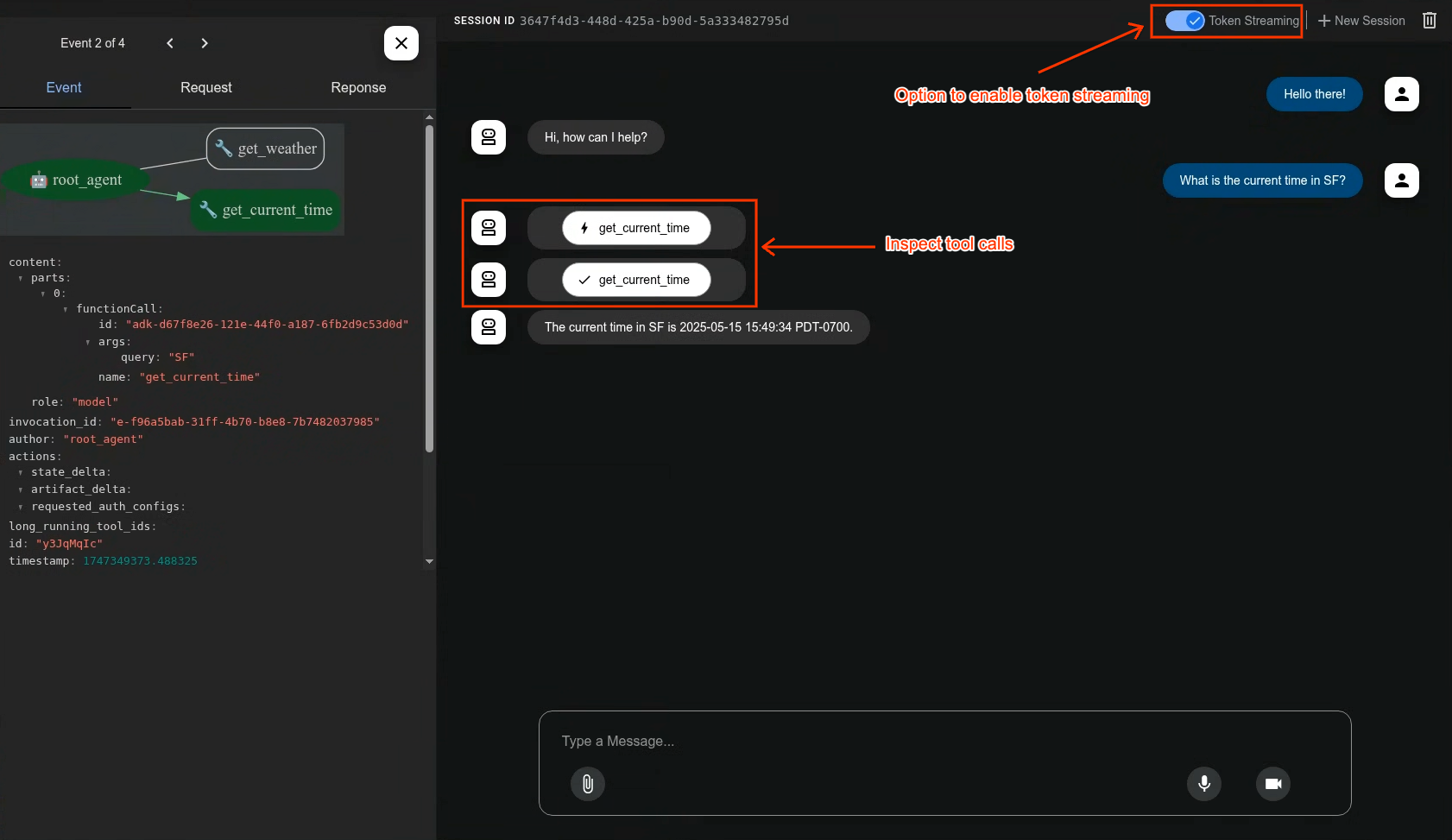
Development UI
A built-in development UI to help you test, evaluate, debug, and showcase your agent(s).
Evaluate Agents
adk eval \
    samples_for_testing/hello_world \
    samples_for_testing/hello_world/hello_world_eval_set_001.evalset.json
🤝 Contributing
We welcome contributions from the community! Whether it's bug reports, feature requests, documentation improvements, or code contributions, please see our
- General contribution guideline and flow.
- Then if you want to contribute code, please read Code Contributing Guidelines to get started.
Community Repo
We have adk-python-community repothat is home to a growing ecosystem of community-contributed tools, third-party service integrations, and deployment scripts that extend the core capabilities of the ADK.
Vibe Coding
If you are to develop agent via vibe coding the llms.txt and the llms-full.txt can be used as context to LLM. While the former one is a summarized one and the later one has the full information in case your LLM has big enough context window.
Community Events
- [Completed] ADK's 1st community meeting on Wednesday, October 15, 2025. Remember to join our group to get access to the recording, and deck.
📄 License
This project is licensed under the Apache 2.0 License - see the LICENSE file for details.
Happy Agent Building!