
 rcsantana777andCopybara-Service
7fe60641e3
rcsantana777andCopybara-Service
7fe60641e3
Merge https://github.com/google/adk-python/pull/2641

This PR adds a custom `User-Agent` header to all requests made via `RestApiTool`. This allows backend services to identify traffic originating from the ADK. The header format is `google-adk/<version> (tool: <tool_name>)`, where `<version>` is the current version of the `google-adk` package, fetched dynamically from `google.adk.version`, and `<tool_name>` is the name of the specific `RestApiTool` instance.

**Associated Issue**

Fixes #2676

**Testing Plan**

**Unit Tests**

I ran the full suite of unit tests locally to ensure the changes did not introduce any regressions. All tests passed successfully.
```bash
$ pytest ./tests/unittests
================================= 4202 passed, 2459 warnings in 44.68s ====================
```
The warnings are related to existing experimental features and are not affected by this change.

**Manual End-to-End (E2E) Test**

I performed a manual test to ensure the integrated flow works as expected.

*   **Setup:** Created a clean virtual environment (`~/venvs/adk-e2e-test`) and installed the locally built `google-adk` package using `uv venv --seed` and `pip install dist/google_adk-*.whl`. Ran a custom `mock_server.py` script (using Flask) in one terminal to listen for requests and print headers. Ran a custom `run_test_tool.py` script in a second terminal to send a request using the modified `RestApiTool`.

*   **Execution:** The `run_test_tool.py` script successfully sent a POST request to the mock server's `/test` endpoint. The mock server received the request and printed the headers.

    **`run_test_tool.py` Output:**
    ```json
    {
      "message": "Request received successfully!"
    }
    ```

    **`mock_server.py` Output (Headers):**
    ```text
    --- Request Received ---
    Headers:
      Host: 127.0.0.1:8000
      User-Agent: google-adk/1.12.0 (tool: TestTool)
      Accept-Encoding: gzip, deflate
      Accept: */*
      Connection: keep-alive
      Content-Type: application/json
      Content-Length: 2
    ------------------------
    ```
    The `User-Agent: google-adk/1.12.0 (tool: TestTool)` header confirms the change is working as intended, dynamically fetching the package version and including the tool name.

**Checklist**

*   [x] Associated issue linked
*   [x] Unit tests passed
*   [x] End-to-end test performed and results documented
*   [x] Code formatted with `./autoformat.sh`

---

COPYBARA_INTEGRATE_REVIEW=https://github.com/google/adk-python/pull/2641 from rcsantana777:feat/add-user-agent a9a9375306c18bb7ba501276cbf76693e70a87ad
PiperOrigin-RevId: 798232385
Agent Development Kit (ADK)





An open-source, code-first Python toolkit for building, evaluating, and deploying sophisticated AI agents with flexibility and control.
Important Links: Docs, Samples, Java ADK & ADK Web.
</html>Agent Development Kit (ADK) is a flexible and modular framework for developing and deploying AI agents. While optimized for Gemini and the Google ecosystem, ADK is model-agnostic, deployment-agnostic, and is built for compatibility with other frameworks. ADK was designed to make agent development feel more like software development, to make it easier for developers to create, deploy, and orchestrate agentic architectures that range from simple tasks to complex workflows.
✨ What's new
- Agent Config: Build agents without code. Check out the Agent Config feature.
✨ Key Features
-
Rich Tool Ecosystem: Utilize pre-built tools, custom functions, OpenAPI specs, or integrate existing tools to give agents diverse capabilities, all for tight integration with the Google ecosystem.
-
Code-First Development: Define agent logic, tools, and orchestration directly in Python for ultimate flexibility, testability, and versioning.
-
Modular Multi-Agent Systems: Design scalable applications by composing multiple specialized agents into flexible hierarchies.
-
Deploy Anywhere: Easily containerize and deploy agents on Cloud Run or scale seamlessly with Vertex AI Agent Engine.
🤖 Agent2Agent (A2A) Protocol and ADK Integration
For remote agent-to-agent communication, ADK integrates with the A2A protocol. See this example for how they can work together.
🚀 Installation
Stable Release (Recommended)
You can install the latest stable version of ADK using pip:
pip install google-adk
The release cadence is weekly.
This version is recommended for most users as it represents the most recent official release.
Development Version
Bug fixes and new features are merged into the main branch on GitHub first. If you need access to changes that haven't been included in an official PyPI release yet, you can install directly from the main branch:
pip install git+https://github.com/google/adk-python.git@main
Note: The development version is built directly from the latest code commits. While it includes the newest fixes and features, it may also contain experimental changes or bugs not present in the stable release. Use it primarily for testing upcoming changes or accessing critical fixes before they are officially released.
📚 Documentation
Explore the full documentation for detailed guides on building, evaluating, and deploying agents:
🏁 Feature Highlight
Define a single agent:
from google.adk.agents import Agent
from google.adk.tools import google_search

root_agent = Agent(
    name="search_assistant",
    model="gemini-2.0-flash", # Or your preferred Gemini model
    instruction="You are a helpful assistant. Answer user questions using Google Search when needed.",
    description="An assistant that can search the web.",
    tools=[google_search]
)
Define a multi-agent system:
Define a multi-agent system with coordinator agent, greeter agent, and task execution agent. Then ADK engine and the model will guide the agents works together to accomplish the task.
from google.adk.agents import LlmAgent, BaseAgent

# Define individual agents
greeter = LlmAgent(name="greeter", model="gemini-2.0-flash", ...)
task_executor = LlmAgent(name="task_executor", model="gemini-2.0-flash", ...)

# Create parent agent and assign children via sub_agents
coordinator = LlmAgent(
    name="Coordinator",
    model="gemini-2.0-flash",
    description="I coordinate greetings and tasks.",
    sub_agents=[ # Assign sub_agents here
        greeter,
        task_executor
    ]
)
Development UI
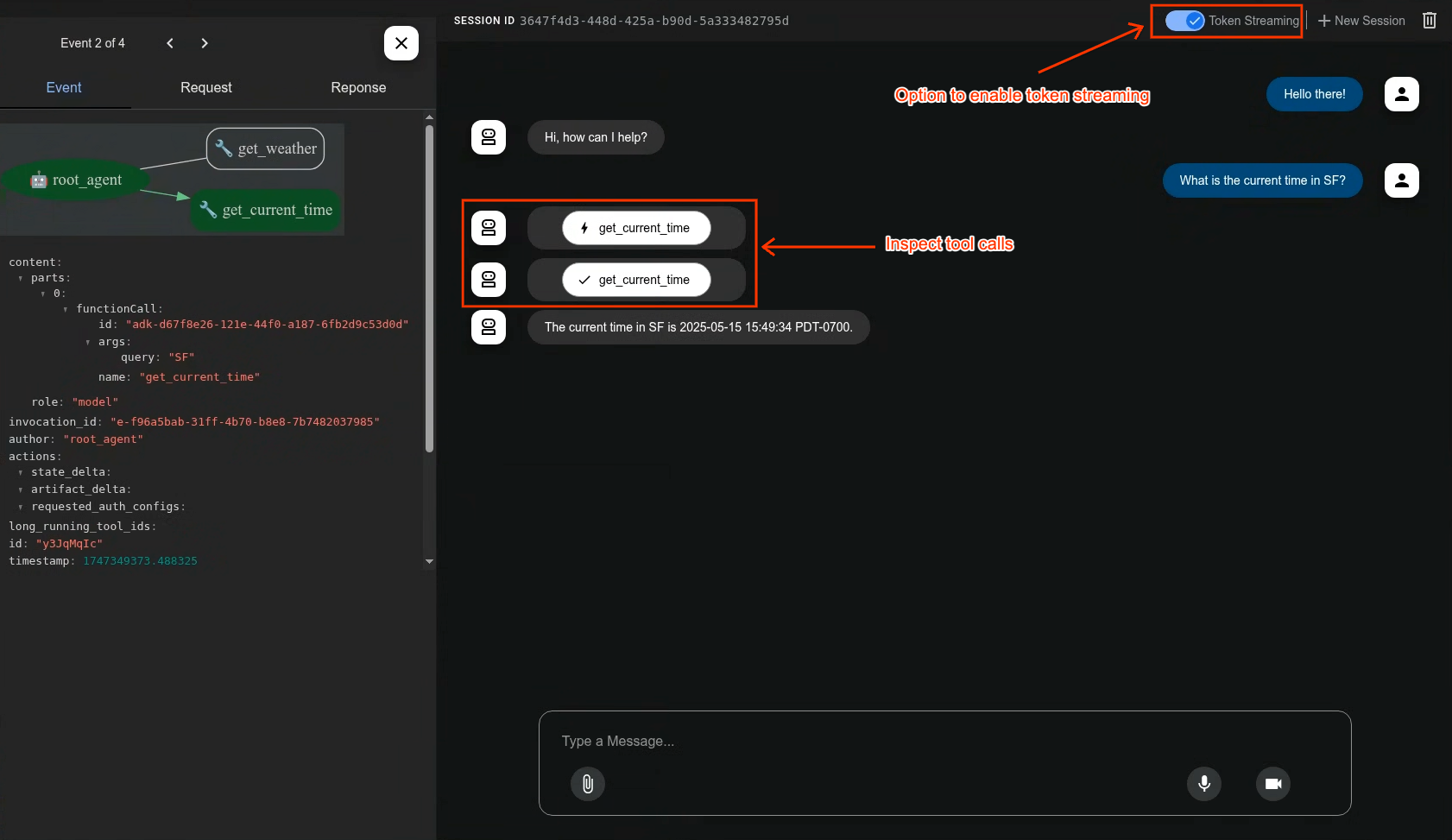
A built-in development UI to help you test, evaluate, debug, and showcase your agent(s).
Evaluate Agents
adk eval \
    samples_for_testing/hello_world \
    samples_for_testing/hello_world/hello_world_eval_set_001.evalset.json
🤝 Contributing
We welcome contributions from the community! Whether it's bug reports, feature requests, documentation improvements, or code contributions, please see our
- General contribution guideline and flow.
- Then if you want to contribute code, please read Code Contributing Guidelines to get started.
Vibe Coding
If you are to develop agent via vibe coding the llms.txt and the llms-full.txt can be used as context to LLM. While the former one is a summarized one and the later one has the full information in case your LLM has big enough context window.
📄 License
This project is licensed under the Apache 2.0 License - see the LICENSE file for details.
Happy Agent Building!