
 Lavi NigamandCopybara-Service
0487eea2ab
Lavi NigamandCopybara-Service
0487eea2ab
Merge https://github.com/google/adk-python/pull/3345

Add run_debug() helper method to InMemoryRunner that reduces agent execution boilerplate from 7-8 lines to just 2 lines, making it ideal for quick experimentation, notebooks, and getting started with ADK.

**Key changes:**
• Introduce run_debug() to reduce boilerplate from 7-8 lines to 2 lines
• Enable quick testing in notebooks, REPL, and during development
• Support single or multiple messages with automatic session management
• Add verbose flag to show/hide tool calls and intermediate processing
• Add quiet flag to suppress console output while capturing events
• Extract event printing logic to reusable utility (utils/_debug_output.py)
• Include comprehensive test suite with 21 test cases covering all part types
• Provide complete working example with 8 usage patterns
• **This is a convenience method for experimentation, not a replacement for run_async()**

### Link to Issue or Description of Change

**1. Link to an existing issue (if applicable):**

* N/A - New feature to improve developer experience

**2. Or, if no issue exists, describe the change:**

**Problem:**

Developers need to write 7-8 lines of boilerplate code just to test a simple agent interaction during development. This creates friction for:

* New developers getting started with ADK
* Quick experimentation in Jupyter notebooks or Python REPL
* Debugging agent behavior during development
* Writing examples and tutorials
* Rapid prototyping of agent capabilities

**Solution:**

Introduce `run_debug()` as a convenience helper method specifically designed for quick experimentation and getting started scenarios. This method:

* **Is NOT a replacement for `run_async()`** - it's a developer convenience tool
* **Reduces boilerplate** from 7-8 lines to just 2 lines for simple testing
* **Handles session management automatically** with sensible defaults
* **Provides debugging visibility** with optional verbose flag for tool calls
* **Supports common patterns** like multiple messages and event capture
* **Type-safe implementation** using direct attribute access instead of getattr()

### Before vs After Comparison

**BEFORE - Current approach requires 7-8 lines of boilerplate:**

```python
from google.adk import Agent
from google.adk.runners import Runner
from google.adk.sessions import InMemorySessionService
from google.genai import types

# Define a simple agent
agent = Agent(
    model="gemini-2.5-flash",
    instruction="You are a helpful assistant"
)

# Need all this boilerplate just to test the agent
APP_NAME = "default"
USER_ID = "default"
session_service = InMemorySessionService()
runner = Runner(agent=agent, app_name=APP_NAME, session_service=session_service)
session = await session_service.create_session(
    app_name=APP_NAME, user_id=USER_ID, session_id="default"
)
content = types.Content(role="user", parts=[types.Part.from_text("Hello")])
async for event in runner.run_async(
    user_id=USER_ID, session_id=session.id, new_message=content
):
    if event.content and event.content.parts:
        print(event.content.parts[0].text)
```

**AFTER - With run_debug() helper, just 2 lines:**

```python
from google.adk import Agent
from google.adk.runners import InMemoryRunner

# Define the same agent
agent = Agent(
    model="gemini-2.5-flash",
    instruction="You are a helpful assistant"
)

# Test it with just 2 lines!
runner = InMemoryRunner(agent=agent)
await runner.run_debug("Hello")
```

### API Design

```python
async def run_debug(
    self,
    user_messages: str | list[str],
    *,
    user_id: str = 'debug_user_id',
    session_id: str = 'debug_session_id',
    run_config: RunConfig | None = None,
    quiet: bool = False,
    verbose: bool = False,
) -> list[Event]:
```

**Parameters:**

* `user_messages`: Single message string or list of messages (required)
* `user_id`: User identifier (default: 'debug_user_id')
* `session_id`: Session identifier for conversation continuity (default: 'debug_session_id')
* `run_config`: Optional advanced configuration
* `quiet`: Suppress console output (default: False)
* `verbose`: Show detailed tool calls and responses (default: False)

**Key Features:**

* **Always returns events** - Simplifies API, no conditional return type
* **Type-safe implementation** - Uses direct attribute access on Pydantic models
* **Text buffering** - Consecutive text parts printed without repeated author prefix
* **Smart truncation** - Long tool args/responses truncated for readability
* **Clean session management** - Get-then-create pattern, no try/except
* **Reusable printing logic** - Extracted to utils/_debug_output.py for other tools

### Implementation Highlights

**1. Event Printing Utility (utils/_debug_output.py):**
* Modular print_event() function for displaying events
* Text buffering to combine consecutive text parts
* Configurable truncation for different content types:
  - Function args: 50 chars max
  - Function responses: 100 chars max
  - Code output: 100 chars max
* Supports all ADK part types (text, function_call, executable_code, inline_data, file_data)

**2. Session Management:**
```python
# Clean get-then-create pattern (no try/except)
session = await self.session_service.get_session(
    app_name=self.app_name, user_id=user_id, session_id=session_id
)
if not session:
    session = await self.session_service.create_session(
        app_name=self.app_name, user_id=user_id, session_id=session_id
    )
```

**3. Type-Safe Event Processing:**
* Direct attribute access on Pydantic models (no getattr() or hasattr())
* Proper handling of all part types
* Leverages `from __future__ import annotations` for duck typing

### Important Note on Scope

`run_debug()` is a **convenience method for experimentation only**. For production applications requiring:

* Custom session services (Spanner, Cloud SQL)
* Fine-grained event processing control
* Error recovery and resumability
* Performance optimization
* Complex authentication flows

Continue using the standard `run_async()` method. The `run_debug()` helper is specifically designed to lower the barrier to entry and speed up the development/testing cycle.

### Testing Plan

**Unit Tests (21 test cases in tests/unittests/runners/test_runner_debug.py):**

**Core functionality (7 tests):**
* ✅ Single message execution and event return
* ✅ Multiple messages in sequence
* ✅ Quiet mode (suppresses output)
* ✅ Custom session_id configuration
* ✅ Custom user_id configuration
* ✅ RunConfig passthrough
* ✅ Session persistence across calls

**Part type handling (8 tests):**
* ✅ Tool calls and responses (verbose mode)
* ✅ Executable code parts
* ✅ Code execution result parts
* ✅ Inline data (images)
* ✅ File data references
* ✅ Mixed part types in single event
* ✅ Long output truncation
* ✅ Verbose flag behavior (show/hide tools)

**Edge cases (6 tests):**
* ✅ None text filtering
* ✅ Existing session handling
* ✅ Empty parts list
* ✅ None event content
* ✅ Verbose=False hides tool calls
* ✅ Verbose=True shows tool calls

**All 21 tests passing in 3.8s** ✓

**Manual End-to-End (E2E) Tests:**

Tested all 8 example patterns in contributing/samples/runner_debug_example/main.py:

1. ✅ Minimal 2-line usage
2. ✅ Multiple sequential messages
3. ✅ Session persistence across calls
4. ✅ Multiple user sessions (Alice & Bob)
5. ✅ Verbose mode for tool visibility
6. ✅ Event capture with quiet mode
7. ✅ Custom RunConfig integration
8. ✅ Before/after comparison

### Files Changed

**Core implementation:**
* src/google/adk/runners.py - Added run_debug() method (~60 lines)
* src/google/adk/utils/_debug_output.py - Event printing utility (~106 lines)

**Tests:**
* tests/unittests/runners/test_runner_debug.py - Comprehensive test suite (21 tests)

**Examples:**
* contributing/samples/runner_debug_example/agent.py - Sample agent with tools
* contributing/samples/runner_debug_example/main.py - 8 usage examples
* contributing/samples/runner_debug_example/README.md - Complete documentation

### Checklist

- [x] I have read the [CONTRIBUTING.md](https://github.com/google/adk-python/blob/main/CONTRIBUTING.md) document
- [x] I have performed a self-review of my own code
- [x] I have commented my code, particularly in hard-to-understand areas
- [x] I have added tests that prove my fix is effective or that my feature works
- [x] New and existing unit tests pass locally with my changes (21/21 passing)
- [x] I have manually tested my changes end-to-end (8 examples tested)
- [x] Code follows ADK style guide (relative imports, type hints, 2-space indentation)
- [x] Ran ./autoformat.sh before committing
- [x] Any dependent changes have been merged and published in downstream modules

### Additional Context

**Example with Tools (verbose mode):**

```python
# Create agent with tools
agent = Agent(
    model="gemini-2.5-flash",
    instruction="You can check weather and do calculations",
    tools=[get_weather, calculate]
)

# Test with verbose to see tool calls
runner = InMemoryRunner(agent=agent)
await runner.run_debug("What's the weather in SF?", verbose=True)

# Output:
# User > What's the weather in SF?
# agent > [Calling tool: get_weather({'city': 'San Francisco'})]
# agent > [Tool result: {'result': 'Foggy, 15°C (59°F)'}]
# agent > The weather in San Francisco is foggy, 15°C (59°F).
```

**Complete Example Included:**

The PR includes a full working example in `contributing/samples/runner_debug_example/` with:
* Agent with weather and calculator tools
* 8 different usage patterns
* Comprehensive README with troubleshooting
* Safe AST-based expression evaluation

**Breaking Changes:** None - this is purely additive.

**Security:** Example uses AST-based expression evaluation instead of eval().

**Code Quality:**
* Type-safe implementation (no getattr() or hasattr())
* Modular design (printing logic separated into utility)
* Follows ADK conventions (relative imports, from __future__ import annotations)
* Comprehensive error handling (gracefully handles None content, empty parts)
* Well-documented with docstrings and inline comments
END_PUBLIC
```

---

## Key Changes from Original:

1. ✅ Updated parameter name: `user_queries` → `user_messages`
2. ✅ Updated parameter name: `session_name` → `session_id`
3. ✅ Updated parameter name: `print_output` → `quiet`
4. ✅ Removed `return_events` parameter
5. ✅ Updated test count: 23 → 21
6. ✅ Changed "queries" → "messages" throughout
7. ✅ Added implementation highlights section
8. ✅ Added details about utils/_debug_output.py
9. ✅ Updated default values to debug_user_id/debug_session_id
10. ✅ Noted type-safe implementation
11. ✅ Added Code Quality section
12. ✅ Updated API signature to match final refactored version
13. ✅ Removed optional return type (always returns list[Event])

Co-authored-by: Wei Sun (Jack) <weisun@google.com>
COPYBARA_INTEGRATE_REVIEW=https://github.com/google/adk-python/pull/3345 from lavinigam-gcp:adk-runner-helper e0050b9f152d0f0e49e6501610d2c59a754fc571
PiperOrigin-RevId: 826607817
Agent Development Kit (ADK)





An open-source, code-first Python framework for building, evaluating, and deploying sophisticated AI agents with flexibility and control.
Important Links: Docs, Samples, Java ADK & ADK Web.
</html>Agent Development Kit (ADK) is a flexible and modular framework that applies software development principles to AI agent creation. It is designed to simplify building, deploying, and orchestrating agent workflows, from simple tasks to complex systems. While optimized for Gemini, ADK is model-agnostic, deployment-agnostic, and compatible with other frameworks.
🔥 What's new
-
Custom Service Registration: Add a service registry to provide a generic way to register custom service implementations to be used in FastAPI server. See short instruction here. (391628f)
-
Rewind: Add the ability to rewind a session to before a previous invocation (9dce06f).
-
New CodeExecutor: Introduces a new AgentEngineSandboxCodeExecutor class that supports executing agent-generated code using the Vertex AI Code Execution Sandbox API (ee39a89)
✨ Key Features
-
Rich Tool Ecosystem: Utilize pre-built tools, custom functions, OpenAPI specs, MCP tools or integrate existing tools to give agents diverse capabilities, all for tight integration with the Google ecosystem.
-
Code-First Development: Define agent logic, tools, and orchestration directly in Python for ultimate flexibility, testability, and versioning.
-
Agent Config: Build agents without code. Check out the Agent Config feature.
-
Tool Confirmation: A tool confirmation flow(HITL) that can guard tool execution with explicit confirmation and custom input.
-
Modular Multi-Agent Systems: Design scalable applications by composing multiple specialized agents into flexible hierarchies.
-
Deploy Anywhere: Easily containerize and deploy agents on Cloud Run or scale seamlessly with Vertex AI Agent Engine.
🚀 Installation
Stable Release (Recommended)
You can install the latest stable version of ADK using pip:
pip install google-adk
The release cadence is roughly bi-weekly.
This version is recommended for most users as it represents the most recent official release.
Development Version
Bug fixes and new features are merged into the main branch on GitHub first. If you need access to changes that haven't been included in an official PyPI release yet, you can install directly from the main branch:
pip install git+https://github.com/google/adk-python.git@main
Note: The development version is built directly from the latest code commits. While it includes the newest fixes and features, it may also contain experimental changes or bugs not present in the stable release. Use it primarily for testing upcoming changes or accessing critical fixes before they are officially released.
🤖 Agent2Agent (A2A) Protocol and ADK Integration
For remote agent-to-agent communication, ADK integrates with the A2A protocol. See this example for how they can work together.
📚 Documentation
Explore the full documentation for detailed guides on building, evaluating, and deploying agents:
🏁 Feature Highlight
Define a single agent:
from google.adk.agents import Agent
from google.adk.tools import google_search

root_agent = Agent(
    name="search_assistant",
    model="gemini-2.5-flash", # Or your preferred Gemini model
    instruction="You are a helpful assistant. Answer user questions using Google Search when needed.",
    description="An assistant that can search the web.",
    tools=[google_search]
)
Define a multi-agent system:
Define a multi-agent system with coordinator agent, greeter agent, and task execution agent. Then ADK engine and the model will guide the agents works together to accomplish the task.
from google.adk.agents import LlmAgent, BaseAgent

# Define individual agents
greeter = LlmAgent(name="greeter", model="gemini-2.5-flash", ...)
task_executor = LlmAgent(name="task_executor", model="gemini-2.5-flash", ...)

# Create parent agent and assign children via sub_agents
coordinator = LlmAgent(
    name="Coordinator",
    model="gemini-2.5-flash",
    description="I coordinate greetings and tasks.",
    sub_agents=[ # Assign sub_agents here
        greeter,
        task_executor
    ]
)
Development UI
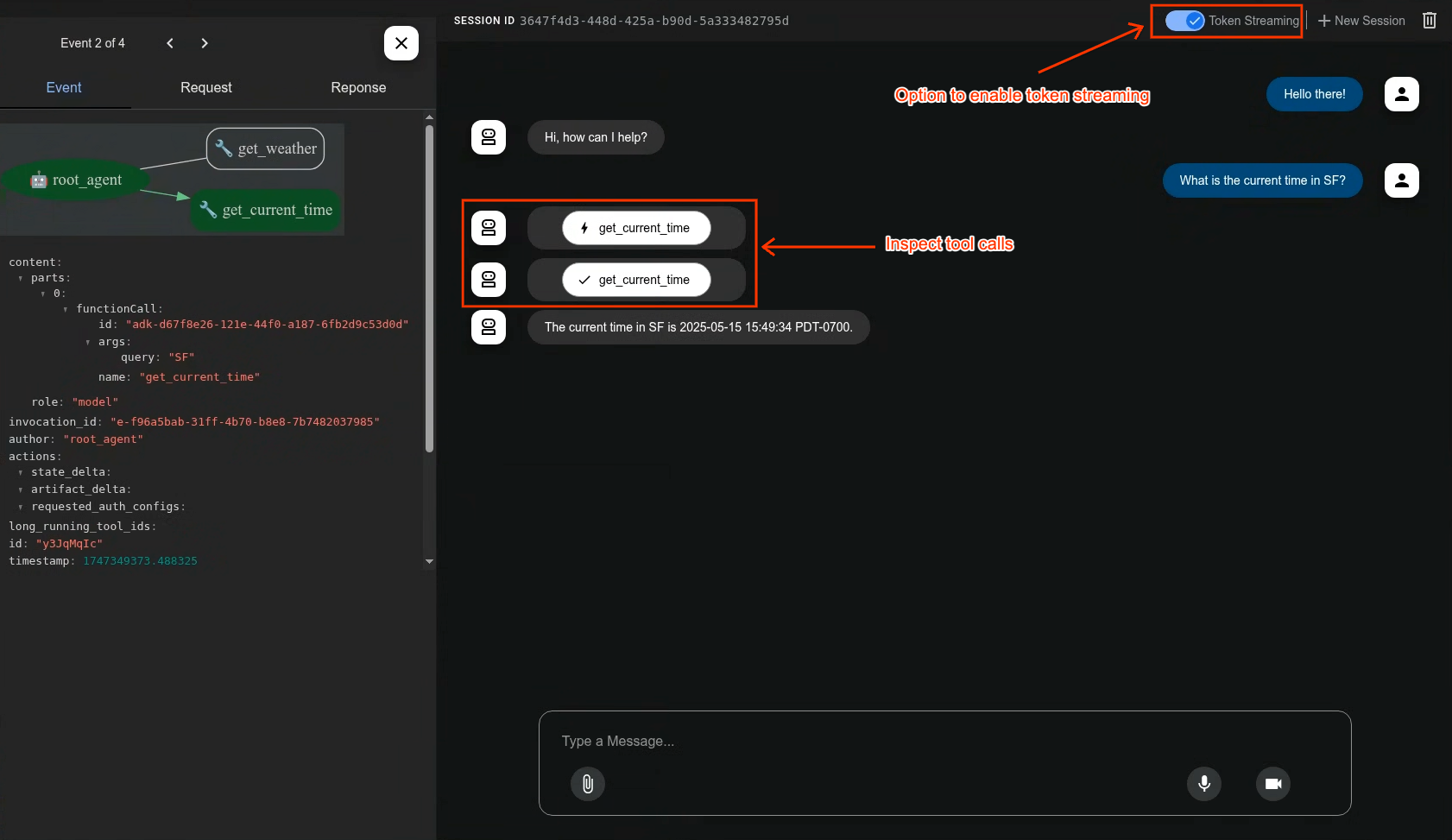
A built-in development UI to help you test, evaluate, debug, and showcase your agent(s).
Evaluate Agents
adk eval \
    samples_for_testing/hello_world \
    samples_for_testing/hello_world/hello_world_eval_set_001.evalset.json
🤝 Contributing
We welcome contributions from the community! Whether it's bug reports, feature requests, documentation improvements, or code contributions, please see our
- General contribution guideline and flow.
- Then if you want to contribute code, please read Code Contributing Guidelines to get started.
Vibe Coding
If you are to develop agent via vibe coding the llms.txt and the llms-full.txt can be used as context to LLM. While the former one is a summarized one and the later one has the full information in case your LLM has big enough context window.
Community Events
- [Completed] ADK's 1st community meeting on Wednesday, October 15, 2025. Remember to join our group to get access to the recording, and deck.
📄 License
This project is licensed under the Apache 2.0 License - see the LICENSE file for details.
Happy Agent Building!