 bmdhacks
bf4e1089a0
bmdhacks
bf4e1089a0
ps2autotests' fpu/fcr.cpp has run MUL.S(0x7F7FFFFF, 0x7F7FFFFF) on hardware all
along, but prints the result with %f, so the only thing it ever recorded was the
string "NaN". This captures the bits: 57 EE FPU rows and 8 VU0 macro-mode rows
from a real PS2 over ps2link, every value a raw word.

One rule accounts for every row:

  The EE FPU's representable maximum is 0x7FFFFFFF == (2 - 2^-23) * 2^128.
  Exponent 255 is an ordinary exponent -- there is no Inf and no NaN. Overflow
  means exceeding THAT, it saturates there, and only then are O and SO raised.

So +FLT_MAX + +FLT_MAX is not an overflow on this machine: the exact sum is
representable and the console returns it with FCR31 untouched. 2^127 * 2 is
likewise fine; 2^127 * 4 is not. The generator asserts both halves of that in
exact rational arithmetic across all 47 arithmetic rows, plus an underflow law
(denormal operands flush to signed zero first, U follows from the flushed
result), and rejects a capture that fails either rather than reshaping it. Both
laws were confirmed live by corrupting the input. div 1.0/+0 is carried as a
known-answer control, and the run is byte-identical across two resets.

That max is one binade above what IEEE single can hold, which is why the fast
path cannot match the console here however the flag test is written -- the host
cannot represent the EE's top octave, so a result the console returns exactly
necessarily arrives as a host overflow. The FULL double path can, and does.

Also settles the VU half named in the same work item: VU0 saturates to
0x7FFFFFFF too and raises MAC O, and a row that overflows x, y and z while
leaving w in range confirms the x=8 y=4 z=2 w=1 nibble layout.

Nothing is "fixed" here. All three console divergences are shared by both
engines and deliberate -- 19 rows are the +/-FLT_MAX saturation compromise, 3
are underflow U|SU needing FZ off, 15 are the overflow pair -- so they are
recorded and left to the hardware-alignment stage.

What is not deliberate, and is what the capture surfaced: SQRT.S is the only op
in iFPU-arm64.cpp whose emitter never clamps its operand. fpuClampInput has
twelve call sites covering ADD/SUB/MUL/DIV/RSQRT and the six accumulator forms;
recSQRT_S_xmm calls it zero times, so an exponent-255 Ft reaches Fsqrt as a host
+Inf and comes back 0x7F7FFFFF where the interpreter lands two binades away.
Unlike the six operand-clamp rows beside it, this does not close under
CHECK_FPU_EXTRA_OVERFLOW, because there is no gate to turn on. The interpreter
is nearer the console on both rows, so the direction is to give SQRT the clamp
the rest of the family has. Recorded as a divergence with a DISABLED tripwire,
not fixed in this commit.

The engine-agreement test asserts the listed rows still diverge as well as that
the unlisted ones agree, so the allowance list cannot go stale silently.

kEngineDivergences does not list rows 3, 11 and 16 (mul 2^128 by 2.0, by 1.0,
add 2^128 + 0) even though they sit in the middle of the operand-clamp block
they look like they belong to. They are not divergences: both engines return the
same result word on all three, and the only thing that ever differed there was
FCR31, which is the O/SO question deferred to the redesign -- see the DISABLED
tripwires in ee_fpu_fcr_console_conformance_tests.cpp. The file says so in
place, so the omission cannot be read as an oversight.

Idea by pstef.
ARMSX2 — Native ARM64 JIT Fork of PCSX2

ARMSX2 is a free and open-source PlayStation 2 (PS2) emulator based on PCSX2. Its purpose is to emulate the PS2's hardware, using a combination of MIPS CPU Interpreters, Recompilers and a Virtual Machine which manages hardware states and PS2 system memory. This allows you to play PS2 games on your phone, PC, or gaming handheld, with many additional features and benefits.
Thank You
The ARMSX2 team is eternally indebted to the PCSX2 project it is based on. We are so fortunate to build on their 20 years of hardcore development.
About This Fork
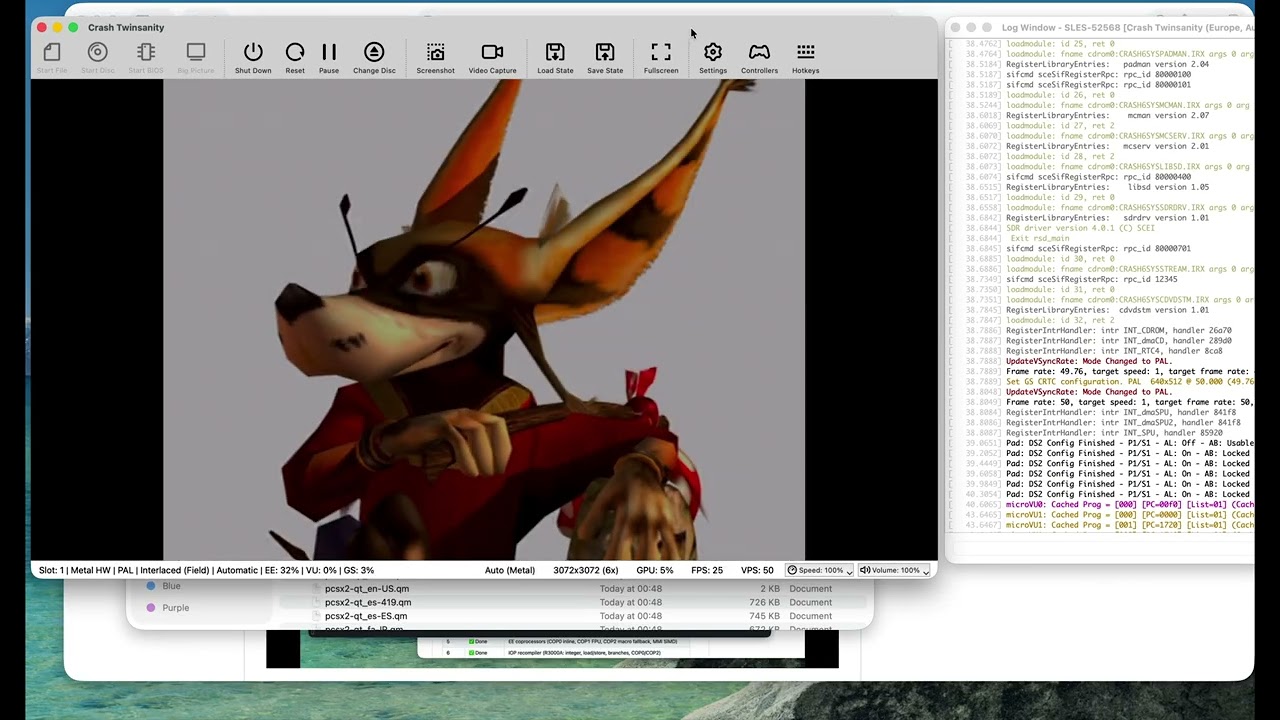
The upstream PCSX2 project ships an ARM64 interpreter build for ARM, but its high-performance JIT recompilers (EE, IOP, VU0, VU1, and vtlb fast memory) are x86-64 only.
This fork exists to close that gap. The goal is to preserve the correctness features of 20 years of PCSX2 development, while generating the fastest native ARM performance possible.
Current status:
- ✅ EE (Emotion Engine) recompiler — integer, float, MMI, COP0/COP1/COP2, branches, load/store
- ✅ IOP (I/O Processor / R3000A) recompiler — full integer, load/store, branches, coprocessors
- ✅ VU (Vector Unit) recompiler — microVU skeleton + Upper FMAC vector ISA complete; Lower ISA and runtime complete
- ✅ vtlb fast memory
- ✅ Native ARM64 binary builds and boots the PS2 BIOS
- ✅ 2D games are already playable
- ✅ 3D games run
Why LLMs / AI Were Used
A word on methodology:
The x86-64 JIT code in upstream ARMSX2 is already proven correct — it has run thousands of PS2 titles for years. The challenge in this port is not emulator design or JIT theory; it is mechanical translation of a large, well-understood x86-64 assembly codebase into equivalent ARM64 assembly (via VIXL) while preserving the exact same register-allocation contracts, block lifecycle, and recompiler semantics.
Large language models (LLMs) were used as an accelerant for this translation work — pattern-matching x86 JIT boilerplate to ARM64 equivalents, scaffolding emit routines, and keeping the porting velocity high. The JIT logic (block compiler, dispatcher, analysis passes, flag pipelines, clamping rules, Tri-Ace hacks, etc.) is taken directly from the upstream x86 implementation and validated against it. Nothing was hallucinated from scratch.
In other words: the hard engineering was done by the PCSX2 team over two decades. The hard typing — translating ~50k lines of x86 emitter code into ARM64 — is what AI helped compress.
System Requirements
ARMSX2 targets ARM64 across desktop (macOS, Windows, Linux) and mobile (Android, iOS/iPadOS), all from the single shared core. Our setup documentation page contains additional details on software and hardware requirements.
Please note that a BIOS dump from a legitimately-owned PS2 console is required to use the emulator. For more information, visit this page.
Building
Check out our github actions for the latest build recipe