 jpolo1224
b8f80aee02
jpolo1224
b8f80aee02
Two reported bugs, unrelated to each other.

RESET (takanome9104, confirmed by lugnel): per-game settings such as affinity and
GS multithreading survived a full reset.

purgeAllSettingsFiles deleted PCSX2-Android.ini and gamesettings/ from
currentInitDataRoot — one root. A device with a configured system directory has
TWO, and on a device that has been moved between them gamesettings/ exists under
both; the surviving copy is re-read on the next launch. Verified on the test
device: gamesettings/ present under BOTH the SD root and app-private storage.
Every known root is purged now. Deleting a file that is already gone is free, so
casting wide costs nothing.

This is the same single-root assumption that hid save states from the library's
long-press menu earlier today. Worth suspecting wherever this codebase resolves
'the' data directory.

The prefs clear also moved from apply() to commit(). restartApp calls
Runtime.exit(0) on the next line, and apply() only guarantees the in-memory
update — its disk write is asynchronous and an abrupt exit can beat it. A reset
that survives the restart is the entire point of the button.

FAST FORWARD (SKrazy on an AYN pad, Shmoda12 on a Thor): Fast Forward (Toggle)
bound to L2/R2 came on for a frame and then reported OFF. It worked as Hold, it
worked on a non-trigger button like R3, and it worked once the pad was switched
to digital triggers.

Those three facts together say it: some pads report a trigger BOTH as an axis and
as a key event, so one pull reaches the hotkey dispatcher twice — once from
sendTrigger, once from the key path. For a HOLD that is harmless, since both
compute the same state from the same edge. For a TOGGLE the first flips it on and
the second immediately flips it back. Digital triggers send only key events, which
is why that setting 'fixed' it.

The axis path now claims the press and the key path skips its own edge. Scoped to
L2/R2 alone so nothing else changes, and cleared on release so the next pull
re-arms. sendTrigger already carried a comment about pads that report triggers
both ways — the hold path had been made safe against them, the hotkey path had
not.
ARMSX2 — Native ARM64 JIT Fork of PCSX2

ARMSX2 is a free and open-source PlayStation 2 (PS2) emulator based on PCSX2. Its purpose is to emulate the PS2's hardware, using a combination of MIPS CPU Interpreters, Recompilers and a Virtual Machine which manages hardware states and PS2 system memory. This allows you to play PS2 games on your phone, PC, or gaming handheld, with many additional features and benefits.
Thank You
The ARMSX2 team is eternally indebted to the PCSX2 project it is based on. We are so fortunate to build on their 20 years of hardcore development.
About This Fork
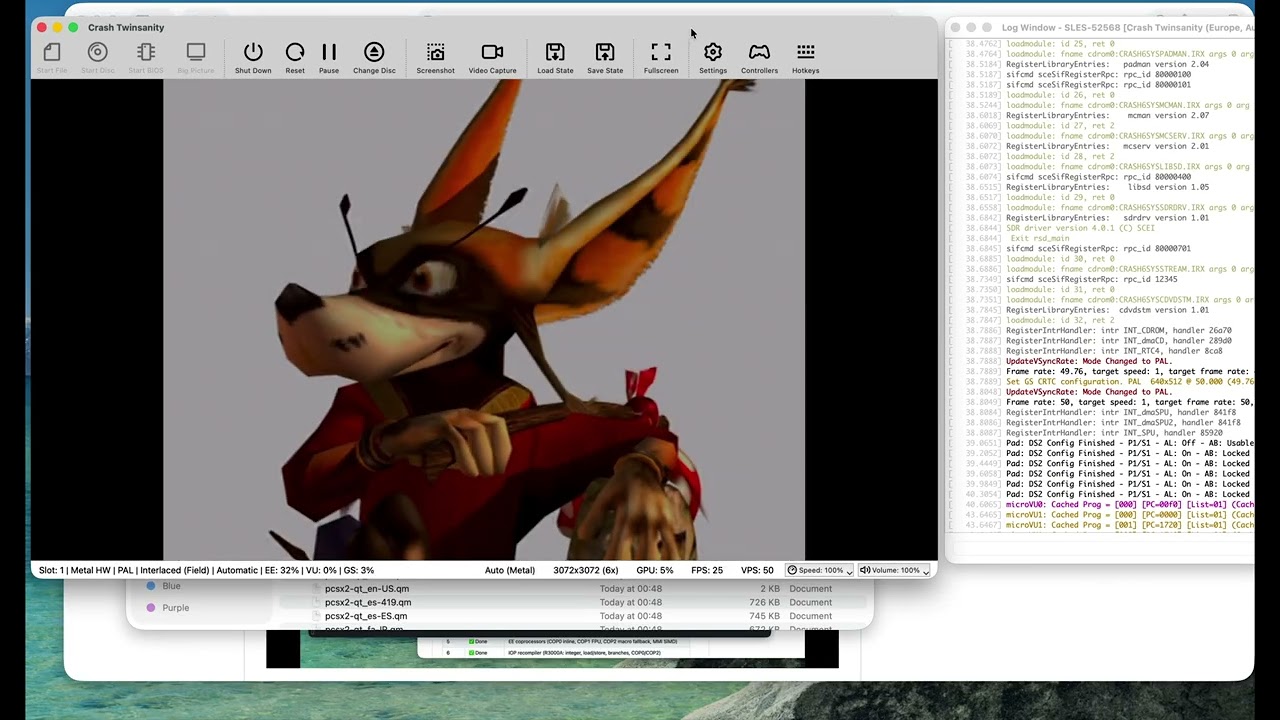
The upstream PCSX2 project ships an ARM64 interpreter build for ARM, but its high-performance JIT recompilers (EE, IOP, VU0, VU1, and vtlb fast memory) are x86-64 only.
This fork exists to close that gap. The goal is to preserve the correctness features of 20 years of PCSX2 development, while generating the fastest native ARM performance possible.
Current status:
- ✅ EE (Emotion Engine) recompiler — integer, float, MMI, COP0/COP1/COP2, branches, load/store
- ✅ IOP (I/O Processor / R3000A) recompiler — full integer, load/store, branches, coprocessors
- ✅ VU (Vector Unit) recompiler — microVU skeleton + Upper FMAC vector ISA complete; Lower ISA and runtime complete
- ✅ vtlb fast memory
- ✅ Native ARM64 binary builds and boots the PS2 BIOS
- ✅ 2D games are already playable
- ✅ 3D games run
Why LLMs / AI Were Used
A word on methodology:
The x86-64 JIT code in upstream ARMSX2 is already proven correct — it has run thousands of PS2 titles for years. The challenge in this port is not emulator design or JIT theory; it is mechanical translation of a large, well-understood x86-64 assembly codebase into equivalent ARM64 assembly (via VIXL) while preserving the exact same register-allocation contracts, block lifecycle, and recompiler semantics.
Large language models (LLMs) were used as an accelerant for this translation work — pattern-matching x86 JIT boilerplate to ARM64 equivalents, scaffolding emit routines, and keeping the porting velocity high. The JIT logic (block compiler, dispatcher, analysis passes, flag pipelines, clamping rules, Tri-Ace hacks, etc.) is taken directly from the upstream x86 implementation and validated against it. Nothing was hallucinated from scratch.
In other words: the hard engineering was done by the PCSX2 team over two decades. The hard typing — translating ~50k lines of x86 emitter code into ARM64 — is what AI helped compress.
System Requirements
ARMSX2 targets ARM64 across desktop (macOS, Windows, Linux) and mobile (Android, iOS/iPadOS), all from the single shared core. Our setup documentation page contains additional details on software and hardware requirements.
Please note that a BIOS dump from a legitimately-owned PS2 console is required to use the emulator. For more information, visit this page.
Building
Check out our github actions for the latest build recipe