 Brian Degenhardt
a6d1e35748
Brian Degenhardt
a6d1e35748
"Copy Global Settings" does not copy the settings you can see. It runs the whole
configuration through a wrapper that writes every key unconditionally, so the file
it leaves behind holds roughly seven hundred of them — network adapters, the
debugger, trace logging, memory cards, sections no settings page ever shows.

That was untidy and no worse, until a key present in a per-game file started
meaning the player claimed it. Now one press of a button whose dialog promises only
that "the configuration for this game will be replaced by the current global
settings" turns off every automatic fix that game had, permanently and silently.

A value is worth writing down only if it decides something, and there are two ways
it can fail to. It can be the stock default, in which case the file carries it as
noise. Or it can be what the game database is going to set anyway, in which case
writing it can only become a claim that suppresses the fix it agrees with. So the
copy now excludes both, and what lands is what the player actually chose.

The comparison goes through the string form rather than the typed value, so a float
or an enum name compares the way it will be stored rather than the way it happens to
sit in memory. That is why the references are built with the same interface class:
same formatting on both sides, exact comparison, one path for every type.

The database reference is a default configuration with the entry applied, not this
one with the entry applied. The question is what the database wants, not where it
would leave the source. It matters for the handful of fixes that clamp rather than
assign, and it errs towards writing the player's value — never towards dropping a
fix, since a value is only skipped when it already equals what the fix would set.

Working the reference out means running the apply functions for an outcome nobody is
going to run with, so they take an apply mode. A hypothetical apply says nothing to
the log, raises none of the recommendation messages, and does not allocate the four
megabyte lookup table that the Goemon TLB fix asks for.

The tests cover the precedence rule and the filter, but the ones that matter are the
drift guards: they assert every gamefix, speedhack and clamp mode has a settings key,
and that the only graphics fixes without one are the six that genuinely have no
setting behind them — three renderer routine selectors and three that only raise a
recommendation. A knob nobody maps is a setting that goes quietly back to being
overridden, with no warning and no failure, and that is what these are here to catch.
ARMSX2 — Native ARM64 JIT Fork of PCSX2

ARMSX2 is a free and open-source PlayStation 2 (PS2) emulator based on PCSX2. Its purpose is to emulate the PS2's hardware, using a combination of MIPS CPU Interpreters, Recompilers and a Virtual Machine which manages hardware states and PS2 system memory. This allows you to play PS2 games on your phone, PC, or gaming handheld, with many additional features and benefits.
Thank You
The ARMSX2 team is eternally indebted to the PCSX2 project it is based on. We are so fortunate to build on their 20 years of hardcore development.
About This Fork
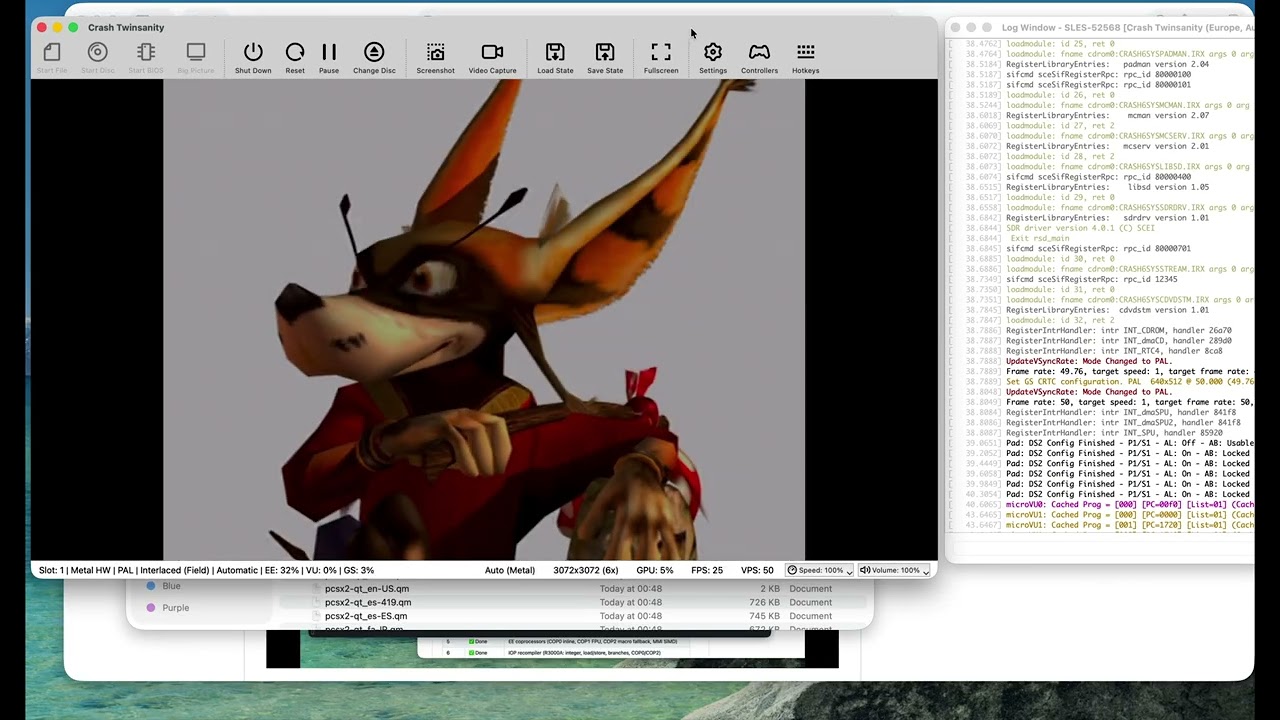
The upstream PCSX2 project ships an ARM64 interpreter build for ARM, but its high-performance JIT recompilers (EE, IOP, VU0, VU1, and vtlb fast memory) are x86-64 only.
This fork exists to close that gap. The goal is to preserve the correctness features of 20 years of PCSX2 development, while generating the fastest native ARM performance possible.
Current status:
- ✅ EE (Emotion Engine) recompiler — integer, float, MMI, COP0/COP1/COP2, branches, load/store
- ✅ IOP (I/O Processor / R3000A) recompiler — full integer, load/store, branches, coprocessors
- ✅ VU (Vector Unit) recompiler — microVU skeleton + Upper FMAC vector ISA complete; Lower ISA and runtime complete
- ✅ vtlb fast memory
- ✅ Native ARM64 binary builds and boots the PS2 BIOS
- ✅ 2D games are already playable
- ✅ 3D games run
Why LLMs / AI Were Used
A word on methodology:
The x86-64 JIT code in upstream ARMSX2 is already proven correct — it has run thousands of PS2 titles for years. The challenge in this port is not emulator design or JIT theory; it is mechanical translation of a large, well-understood x86-64 assembly codebase into equivalent ARM64 assembly (via VIXL) while preserving the exact same register-allocation contracts, block lifecycle, and recompiler semantics.
Large language models (LLMs) were used as an accelerant for this translation work — pattern-matching x86 JIT boilerplate to ARM64 equivalents, scaffolding emit routines, and keeping the porting velocity high. The JIT logic (block compiler, dispatcher, analysis passes, flag pipelines, clamping rules, Tri-Ace hacks, etc.) is taken directly from the upstream x86 implementation and validated against it. Nothing was hallucinated from scratch.
In other words: the hard engineering was done by the PCSX2 team over two decades. The hard typing — translating ~50k lines of x86 emitter code into ARM64 — is what AI helped compress.
System Requirements
ARMSX2 targets ARM64 across desktop (macOS, Windows, Linux) and mobile (Android, iOS/iPadOS), all from the single shared core. Our setup documentation page contains additional details on software and hardware requirements.
Please note that a BIOS dump from a legitimately-owned PS2 console is required to use the emulator. For more information, visit this page.
Building
Check out our github actions for the latest build recipe