 jpolo1224
81d0a3e510
jpolo1224
81d0a3e510
ARMSX2 had Flurry alone. This brings over the Really Slick Screensavers tree
ARMSX3 already runs -- Flux, Plasma, SolarWinds, Hyperspace, Lattice and
Skyrocket -- as one libsavers.so beside libflurry.so.

Terry Welsh's savers, GPL-2.0-OR-LATER, which this tree may take under the "or
later" clause. Nothing here comes from rss-glx: that Linux port is GPL-2.0-only
and cannot go into ARMSX2 at all, which is why Lattice and Skyrocket were
hand-ported from the Windows sources upstream rather than taken from the neutral
versions rss-glx already has. The per-file header is what decides this, not the
repository's LICENSE file; they disagree.

The saver sources build with RS_XSCREENSAVER, selecting their platform-neutral
path, against the GLES2 shim in savers/compat and savers/gl1.c rather than being
rewritten -- so they stay re-pullable and recognisably his code.

Four things the tree carries that are not obvious from the sources:

  - The GL thread takes a 16MB stack. Skyrocket's World constructor declares a
    1024x1024x3 starmap as a local, and a default stack is a SIGSEGV inside
    memset before the first frame draws.
  - Each saver is compiled through a *_unit.cpp that wraps it in a namespace.
    They all declare draw/idleProc/cleanUp/readyToDraw, because each was built as
    its own executable, and two in one .so collide at link. The shared libraries
    must be pre-included OUTSIDE the namespace or the declarations never match
    their definitions -- which compiles clean and fails at link.
  - The lifecycle is serialised by a mutex and a generation token: gl1 keeps its
    state in one global, so a view may only free the run it started. Without it
    the first selection works and every later one is black.
  - gl1_frame_begin() masks alpha off after the first frames. These savers fade
    the previous frame rather than clearing, and that fade writes destination
    alpha, dragging a composited surface transparent -- which reaches the screen
    as full-screen TV static.

Hyperspace runs with dShaders = 0 (its ARB shader path needs objects GLES2 does
not have; upstream exposes this as -shaders 0 and falls back to it itself), and
Skyrocket with dSound = 0 (upstream drives OpenAL and bakes ~7MB of samples into
headers; soundEngine.h is a stub here). Hyperspace and Skyrocket ship no presets
upstream, so neither shows a preset picker -- invented ranges are what made
earlier ports fail to start.

SaverGlView replaces FlurryGlView, which it supersedes: it hosts Flurry and the
Really Slick savers behind one SaverSpec, and keeping both would have declared
FlurryNative twice in one package. Helios is deliberately absent -- it rendered
but animated wrongly and the cause was never found.
ARMSX2 — Native ARM64 JIT Fork of PCSX2

ARMSX2 is a free and open-source PlayStation 2 (PS2) emulator based on PCSX2. Its purpose is to emulate the PS2's hardware, using a combination of MIPS CPU Interpreters, Recompilers and a Virtual Machine which manages hardware states and PS2 system memory. This allows you to play PS2 games on your phone, PC, or gaming handheld, with many additional features and benefits.
Thank You
The ARMSX2 team is eternally indebted to the PCSX2 project it is based on. We are so fortunate to build on their 20 years of hardcore development.
About This Fork
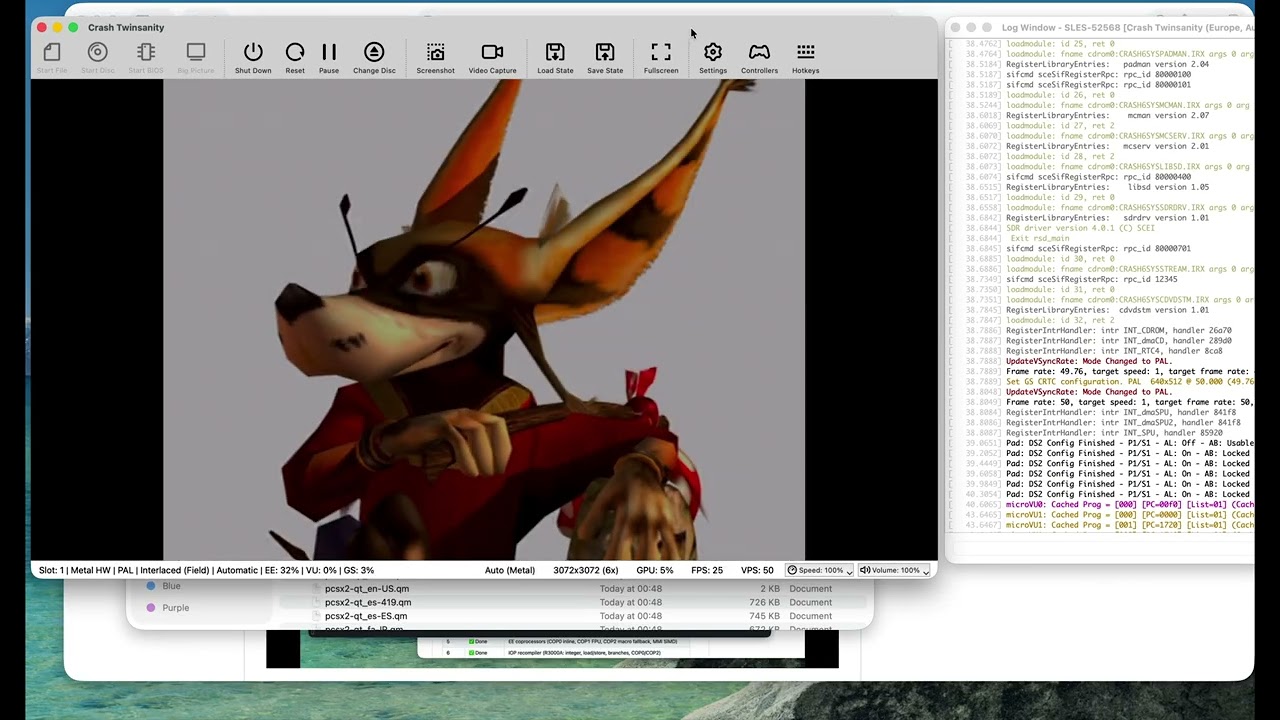
The upstream PCSX2 project ships an ARM64 interpreter build for ARM, but its high-performance JIT recompilers (EE, IOP, VU0, VU1, and vtlb fast memory) are x86-64 only.
This fork exists to close that gap. The goal is to preserve the correctness features of 20 years of PCSX2 development, while generating the fastest native ARM performance possible.
Current status:
- ✅ EE (Emotion Engine) recompiler — integer, float, MMI, COP0/COP1/COP2, branches, load/store
- ✅ IOP (I/O Processor / R3000A) recompiler — full integer, load/store, branches, coprocessors
- ✅ VU (Vector Unit) recompiler — microVU skeleton + Upper FMAC vector ISA complete; Lower ISA and runtime complete
- ✅ vtlb fast memory
- ✅ Native ARM64 binary builds and boots the PS2 BIOS
- ✅ 2D games are already playable
- ✅ 3D games run
Why LLMs / AI Were Used
A word on methodology:
The x86-64 JIT code in upstream ARMSX2 is already proven correct — it has run thousands of PS2 titles for years. The challenge in this port is not emulator design or JIT theory; it is mechanical translation of a large, well-understood x86-64 assembly codebase into equivalent ARM64 assembly (via VIXL) while preserving the exact same register-allocation contracts, block lifecycle, and recompiler semantics.
Large language models (LLMs) were used as an accelerant for this translation work — pattern-matching x86 JIT boilerplate to ARM64 equivalents, scaffolding emit routines, and keeping the porting velocity high. The JIT logic (block compiler, dispatcher, analysis passes, flag pipelines, clamping rules, Tri-Ace hacks, etc.) is taken directly from the upstream x86 implementation and validated against it. Nothing was hallucinated from scratch.
In other words: the hard engineering was done by the PCSX2 team over two decades. The hard typing — translating ~50k lines of x86 emitter code into ARM64 — is what AI helped compress.
System Requirements
ARMSX2 targets ARM64 across desktop (macOS, Windows, Linux) and mobile (Android, iOS/iPadOS), all from the single shared core. Our setup documentation page contains additional details on software and hardware requirements.
Please note that a BIOS dump from a legitimately-owned PS2 console is required to use the emulator. For more information, visit this page.
Building
Check out our github actions for the latest build recipe