 jpolo1224
5e1d979b4e
jpolo1224
5e1d979b4e
Ports the frame-generation implementation from Eden (eden-emu PR #4263), which
is a substantially better design than the lsfg-vk-android one we currently ship.

Why it is better, concretely. Ours runs framegen on its OWN VkDevice, shares
images through AHardwareBuffer, and — because Android gives no cross-device
semaphore, Turnip rejecting OPAQUE_FD on AHB memory — uses full device idles as
its only barrier. Eden's runs as ordinary compute on the device we already have.
It also needs none of what ours drags in: no DXVK dxbc compiler (its shader
translate is a SPIR-V validate plus a descriptor-binding renumber, because
current Lossless.dll ships SPIR-V in its RCDATA resources), no pe-parse, no volk
and its 759-symbol collision with VKLoader, no separate .so, no C ABI, no dlopen,
and no -fexceptions carve-out.

It also brings a real frame PACER, which is the answer to games that oscillate
between 60 and 30fps on a 60Hz panel. A fixed multiplier presents 120 then 60
there and judders at every transition; the pacer varies the generation count to
hold the OUTPUT near a target instead. New GSConfig.LsfgTargetRate drives it,
defaulting to 0 = the existing fixed-multiplier behaviour, so this is opt-in.

Nothing is wired up yet — GSLsfg still drives the old path. This commit is the
ported library only.

★ The load-bearing decision is LsfgVkCompat. The pass code is written against
yuzu's RAII wrapper and its Device/MemoryAllocator, which PCSX2 has no analogue
for. Rather than rewrite ~2000 lines of call sites, the slice of that API the
code actually uses is reimplemented over PCSX2's raw handles and VMA — it came
to five command-buffer methods, three Device queries, two allocator entry points
and eight handle types. The result is that every pass body is BYTE-IDENTICAL to
Eden's, so upstream fixes stay a readable diff instead of a merge puzzle.

Deliberate departures, each commented at the site:
  · paths are std::string, not std::filesystem — the GS backend uses neither
  · CityHash -> GSXXH3_64bits, already used elsewhere in GS
  · the shader cache gained mtime + a flags field so a hit costs a stat() rather
    than a full read, hash and PE walk of the DLL on every launch; Eden keys on
    a content hash and so must read the whole file before it may look at the
    cache. GSLsfg.cpp already validates on size+mtime, so this matches the tree.
  · Eden's RemoveInstalledLosslessDll() is NOT ported. It deletes the DLL, which
    is safe there because Eden owns that file; here the path is whatever
    GSConfig.LsfgDllPath says and nothing checks it points inside our storage.
    Only the cache half is kept, as ClearShaderCache().
  · vk::Buffer gained Flush(). The port initially dropped Eden's flush because
    the shim had nothing to flush through. That write is the shader's entire
    uniform block, and the failure mode is not a crash — it is interpolation
    reading stale constants, which reads as a motion artefact, not a bug.

Verified: all 14 translation units compile clean against the real PCSX2 headers
under -Wall -Wextra. The reconstructed util.cpp helpers were diffed against the
genuine Eden source fetched from the merge commit — the extracted diff hunks in
the working copy are PARTIAL, added lines only, so they were not safe to trust.
ARMSX2 — Native ARM64 JIT Fork of PCSX2

ARMSX2 is a free and open-source PlayStation 2 (PS2) emulator based on PCSX2. Its purpose is to emulate the PS2's hardware, using a combination of MIPS CPU Interpreters, Recompilers and a Virtual Machine which manages hardware states and PS2 system memory. This allows you to play PS2 games on your phone, PC, or gaming handheld, with many additional features and benefits.
Thank You
The ARMSX2 team is eternally indebted to the PCSX2 project it is based on. We are so fortunate to build on their 20 years of hardcore development.
About This Fork
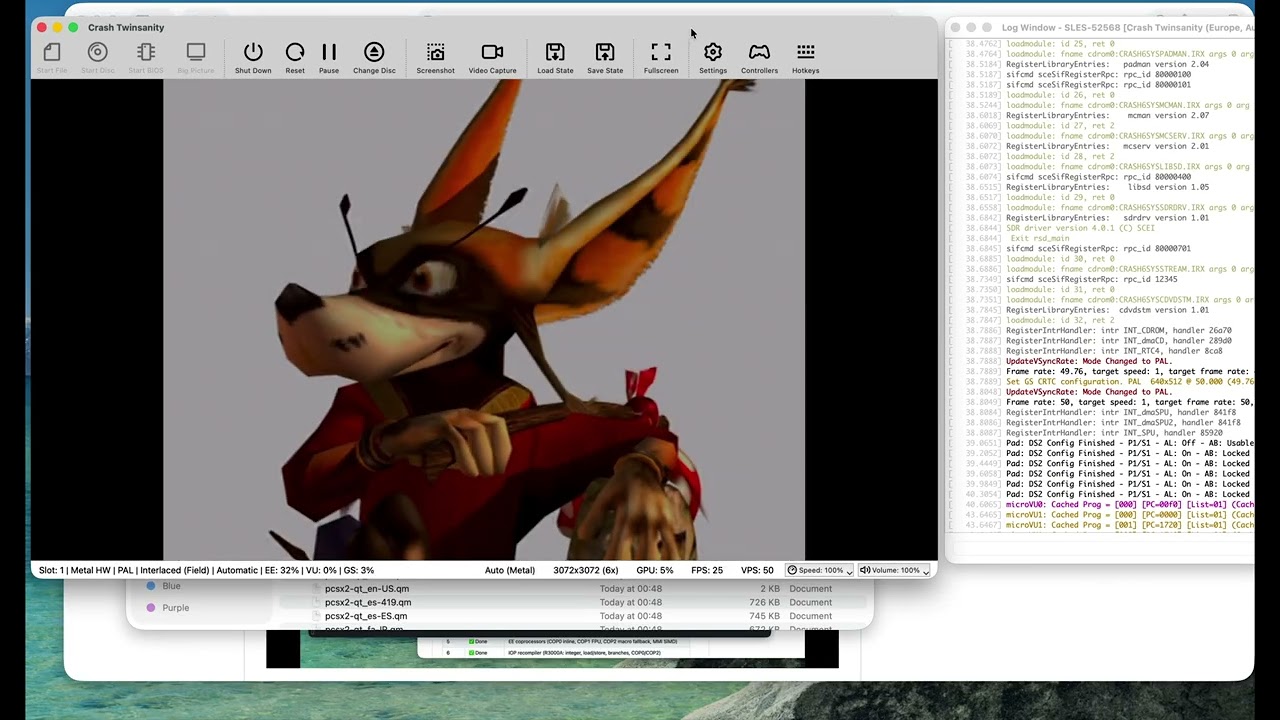
The upstream PCSX2 project ships an ARM64 interpreter build for ARM, but its high-performance JIT recompilers (EE, IOP, VU0, VU1, and vtlb fast memory) are x86-64 only.
This fork exists to close that gap. The goal is to preserve the correctness features of 20 years of PCSX2 development, while generating the fastest native ARM performance possible.
Current status:
- ✅ EE (Emotion Engine) recompiler — integer, float, MMI, COP0/COP1/COP2, branches, load/store
- ✅ IOP (I/O Processor / R3000A) recompiler — full integer, load/store, branches, coprocessors
- ✅ VU (Vector Unit) recompiler — microVU skeleton + Upper FMAC vector ISA complete; Lower ISA and runtime complete
- ✅ vtlb fast memory
- ✅ Native ARM64 binary builds and boots the PS2 BIOS
- ✅ 2D games are already playable
- ✅ 3D games run
Why LLMs / AI Were Used
A word on methodology:
The x86-64 JIT code in upstream ARMSX2 is already proven correct — it has run thousands of PS2 titles for years. The challenge in this port is not emulator design or JIT theory; it is mechanical translation of a large, well-understood x86-64 assembly codebase into equivalent ARM64 assembly (via VIXL) while preserving the exact same register-allocation contracts, block lifecycle, and recompiler semantics.
Large language models (LLMs) were used as an accelerant for this translation work — pattern-matching x86 JIT boilerplate to ARM64 equivalents, scaffolding emit routines, and keeping the porting velocity high. The JIT logic (block compiler, dispatcher, analysis passes, flag pipelines, clamping rules, Tri-Ace hacks, etc.) is taken directly from the upstream x86 implementation and validated against it. Nothing was hallucinated from scratch.
In other words: the hard engineering was done by the PCSX2 team over two decades. The hard typing — translating ~50k lines of x86 emitter code into ARM64 — is what AI helped compress.
System Requirements
ARMSX2 targets ARM64 across desktop (macOS, Windows, Linux) and mobile (Android, iOS/iPadOS), all from the single shared core. Our setup documentation page contains additional details on software and hardware requirements.
Please note that a BIOS dump from a legitimately-owned PS2 console is required to use the emulator. For more information, visit this page.
Building
Check out our github actions for the latest build recipe