 Brian Degenhardt
3e56da7f86
Brian Degenhardt
3e56da7f86
71 commits from474ad59818to2cf8dabe6b, triaged rather than taken wholesale. Declined, resolved to ours: - AGENTS.md: upstream's AI-agent instructions; we carry our own and do not want a second, conflicting policy file. - CI deps bump (setup-node, labeler): both target workflows are absent here, and the labeler job is gated on the repository being PCSX2/pcsx2. - KDDockWidgets 2.4.1: two of the six files do not exist here; we already build 2.4.0 against a 2.3.0 floor, so there is nothing to gain. - The FullscreenUI Achievements-layout realignment: our section already carries the same settings, and ours is the branded copy. - The GS draw/vertex-buffer cluster (7887919e74,b2fa00844e,99cfbb49c1,5c611f85e1,9945046a49,af48193ebb,d88510e3a6,8c1bb5742e). Our vertex kick is an ARM64 rewrite of the same hot path -- register-resident cursor, fused min/max with a rewind watermark, and a scalar cull mirror that dual-issues against the NEON parse -- so upstream's generic pointer-logic optimisation is a variant of work already banked here, and their growth restructure replaces per-buffer capacity with a single global value, which the pooled draw-node model cannot express. Two of the four August commits in that cluster repair regressions the July rewrite introduced, and the third's genuine fix (staging arrays sized from an unrelated buffer) we had already made independently. Taken with adjustment: - EATAN coefficients (aae9438f98). Upstream relabelled mVU_Globals so the names match the powers; we had fixed the same defect by ordering the arm64 call sites by power instead. Both fixes are correct alone and CANCEL when combined, so the arm64 call sites move to plain ascending order in the same commit. The values never moved, so this emits an identical instruction sequence. Their fix also repairs the x86 mVU we still carry. - Shader cache version: upstream numbered their tfx.glsl change 109, which is below our 110. Taking their value would hand every user a stale blob, so this lands as 111. - FullscreenUI: took the two readback-spin toggles, placed outside our non-Apple guard rather than inside upstream's unguarded run. - Restored tools/generate_fullscreen_ui_translation_strings.py, dropped by431ca0c063, and regenerated both string areas. That also registers the Big Picture setup-wizard strings, which had never been extractable. GameDB: the three serials upstream gave gsHWFixes (SLES-53869, PAPX-90020, SCPS-15064) are absent from the mobile overlay, so no fix is silently erased on handhelds.
ARMSX2 — Native ARM64 JIT Fork of PCSX2

ARMSX2 is a free and open-source PlayStation 2 (PS2) emulator based on PCSX2. Its purpose is to emulate the PS2's hardware, using a combination of MIPS CPU Interpreters, Recompilers and a Virtual Machine which manages hardware states and PS2 system memory. This allows you to play PS2 games on your phone, PC, or gaming handheld, with many additional features and benefits.
Thank You
The ARMSX2 team is eternally indebted to the PCSX2 project it is based on. We are so fortunate to build on their 20 years of hardcore development.
About This Fork
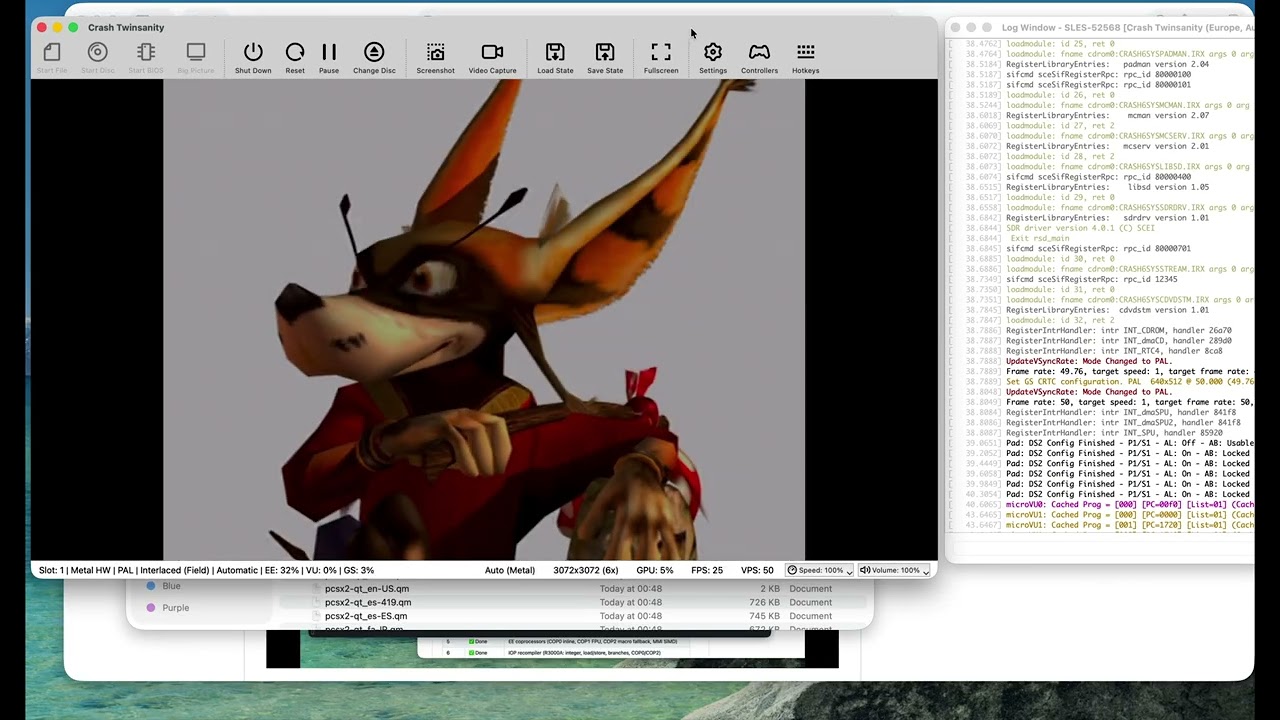
The upstream PCSX2 project ships an ARM64 interpreter build for ARM, but its high-performance JIT recompilers (EE, IOP, VU0, VU1, and vtlb fast memory) are x86-64 only.
This fork exists to close that gap. The goal is to preserve the correctness features of 20 years of PCSX2 development, while generating the fastest native ARM performance possible.
Current status:
- ✅ EE (Emotion Engine) recompiler — integer, float, MMI, COP0/COP1/COP2, branches, load/store
- ✅ IOP (I/O Processor / R3000A) recompiler — full integer, load/store, branches, coprocessors
- ✅ VU (Vector Unit) recompiler — microVU skeleton + Upper FMAC vector ISA complete; Lower ISA and runtime complete
- ✅ vtlb fast memory
- ✅ Native ARM64 binary builds and boots the PS2 BIOS
- ✅ 2D games are already playable
- ✅ 3D games run
Why LLMs / AI Were Used
A word on methodology:
The x86-64 JIT code in upstream ARMSX2 is already proven correct — it has run thousands of PS2 titles for years. The challenge in this port is not emulator design or JIT theory; it is mechanical translation of a large, well-understood x86-64 assembly codebase into equivalent ARM64 assembly (via VIXL) while preserving the exact same register-allocation contracts, block lifecycle, and recompiler semantics.
Large language models (LLMs) were used as an accelerant for this translation work — pattern-matching x86 JIT boilerplate to ARM64 equivalents, scaffolding emit routines, and keeping the porting velocity high. The JIT logic (block compiler, dispatcher, analysis passes, flag pipelines, clamping rules, Tri-Ace hacks, etc.) is taken directly from the upstream x86 implementation and validated against it. Nothing was hallucinated from scratch.
In other words: the hard engineering was done by the PCSX2 team over two decades. The hard typing — translating ~50k lines of x86 emitter code into ARM64 — is what AI helped compress.
System Requirements
ARMSX2 targets ARM64 across desktop (macOS, Windows, Linux) and mobile (Android, iOS/iPadOS), all from the single shared core. Our setup documentation page contains additional details on software and hardware requirements.
Please note that a BIOS dump from a legitimately-owned PS2 console is required to use the emulator. For more information, visit this page.
Building
Check out our github actions for the latest build recipe