 J1coding
2f3f28faae
J1coding
2f3f28faae
A skip cutscene cheat for God of War 2 keeps working with RetroAchievements
Hardcore active. It is not a user file. It ships in our own patches.zip:

  gametitle=God of War 2 (SCUS-97481)
  [Widescreen 16:9]  gsaspectratio=16:9  patch=1,EE,00234A48,word,46000406
  [Skip Cutscenes]   author=Ezedequias   patch=1,EE,202D8194,byte,01

Hardcore only ever gated the cheats side. ReloadEnabledLists empties the enabled
cheats list, the on-disk walk skips the cheats folder, and the cheat enable call
sits behind EnableCheats. The patches list gets none of that: it is re-read
verbatim and applied unconditionally, not even behind EnablePatches. Anything
filed as a patch has always been exempt, and place=1 reapplies it every vsync.

Neither of the obvious rules can separate those two groups. They live in the same
pnach, so file location cannot, and the widescreen one writes EE memory too, so
"block memory writes" would take widescreen with it. What does separate them is
whether the group says what it is for. gsaspectratio or gsinterlacemode means
widescreen or no-interlacing, which we deliberately keep working under Hardcore.
A group that declares nothing and only writes memory is a cheat whatever its
label says.

Measured against the shipped database before settling on it: 1284 groups declare
presentation and stay, 478 write memory with nothing declared and now stop. The
ones that stop read like Car select, Auto-activate analogs and Throttle/brake on
right stick. On the reported game, Widescreen 16:9 stays and Skip Cutscenes goes.

The check runs at group selection rather than against the enable list, because an
unlabelled group never consults that list and would have sailed through a filter
applied there.

GameDB patches are left alone on purpose. They are a curated compatibility layer,
and dropping them under Hardcore would break games instead of stopping cheating.

Worth knowing what this does not cover: a pnach author can still launder a cheat
by pasting a gsaspectratio line into the group. That stops shipped and accidental
content, not somebody determined to cheat themselves.
ARMSX2 — Native ARM64 JIT Fork of PCSX2

ARMSX2 is a free and open-source PlayStation 2 (PS2) emulator based on PCSX2. Its purpose is to emulate the PS2's hardware, using a combination of MIPS CPU Interpreters, Recompilers and a Virtual Machine which manages hardware states and PS2 system memory. This allows you to play PS2 games on your phone, PC, or gaming handheld, with many additional features and benefits.
Thank You
The ARMSX2 team is eternally indebted to the PCSX2 project it is based on. We are so fortunate to build on their 20 years of hardcore development.
About This Fork
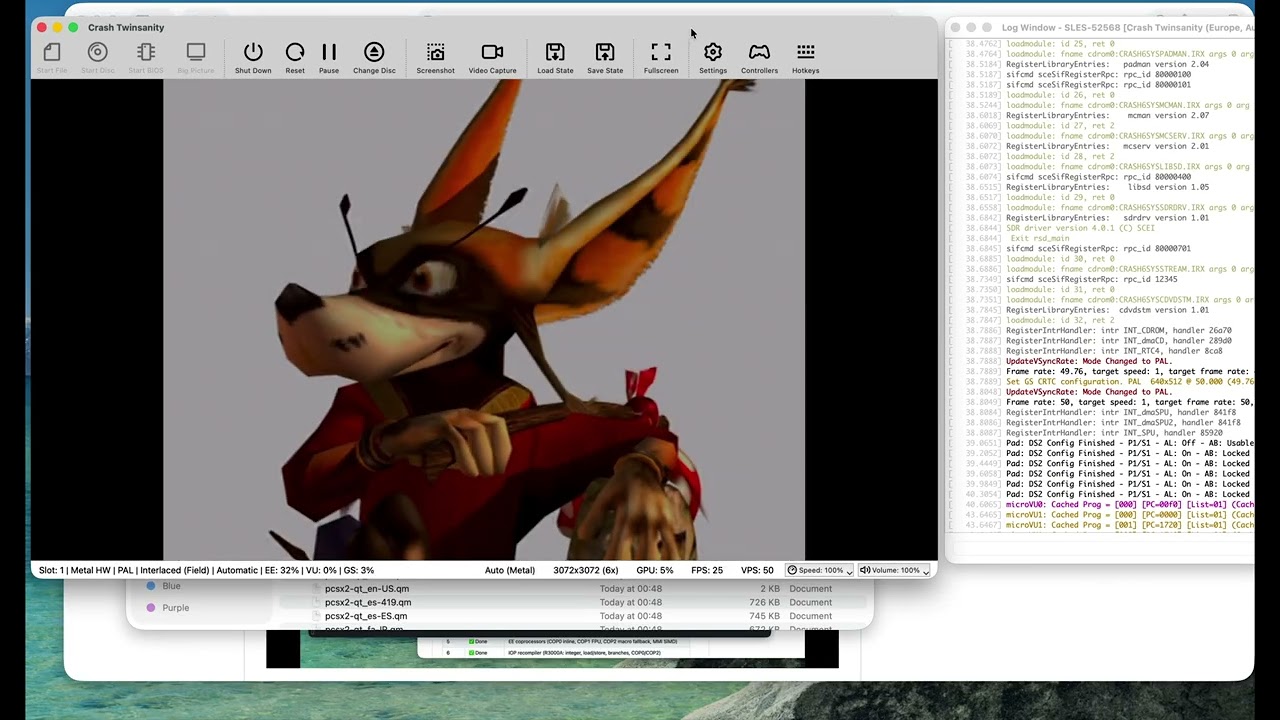
The upstream PCSX2 project ships an ARM64 interpreter build for ARM, but its high-performance JIT recompilers (EE, IOP, VU0, VU1, and vtlb fast memory) are x86-64 only.
This fork exists to close that gap. The goal is to preserve the correctness features of 20 years of PCSX2 development, while generating the fastest native ARM performance possible.
Current status:
- ✅ EE (Emotion Engine) recompiler — integer, float, MMI, COP0/COP1/COP2, branches, load/store
- ✅ IOP (I/O Processor / R3000A) recompiler — full integer, load/store, branches, coprocessors
- ✅ VU (Vector Unit) recompiler — microVU skeleton + Upper FMAC vector ISA complete; Lower ISA and runtime complete
- ✅ vtlb fast memory
- ✅ Native ARM64 binary builds and boots the PS2 BIOS
- ✅ 2D games are already playable
- ✅ 3D games run
Why LLMs / AI Were Used
A word on methodology:
The x86-64 JIT code in upstream ARMSX2 is already proven correct — it has run thousands of PS2 titles for years. The challenge in this port is not emulator design or JIT theory; it is mechanical translation of a large, well-understood x86-64 assembly codebase into equivalent ARM64 assembly (via VIXL) while preserving the exact same register-allocation contracts, block lifecycle, and recompiler semantics.
Large language models (LLMs) were used as an accelerant for this translation work — pattern-matching x86 JIT boilerplate to ARM64 equivalents, scaffolding emit routines, and keeping the porting velocity high. The JIT logic (block compiler, dispatcher, analysis passes, flag pipelines, clamping rules, Tri-Ace hacks, etc.) is taken directly from the upstream x86 implementation and validated against it. Nothing was hallucinated from scratch.
In other words: the hard engineering was done by the PCSX2 team over two decades. The hard typing — translating ~50k lines of x86 emitter code into ARM64 — is what AI helped compress.
System Requirements
ARMSX2 targets ARM64 across desktop (macOS, Windows, Linux) and mobile (Android, iOS/iPadOS), all from the single shared core. Our setup documentation page contains additional details on software and hardware requirements.
Please note that a BIOS dump from a legitimately-owned PS2 console is required to use the emulator. For more information, visit this page.
Building
Check out our github actions for the latest build recipe