lib/interval_tree.c provides a simple interface for an interval-tree
(an augmented red-black tree) but is only built when testing the generic
macros for building interval-trees. For drivers with modest needs,
export the simple interval-tree library as is.

v2: Lots of help from Michel Lespinasse to only compile the code
    as required:
    - make INTERVAL_TREE a config option
    - make INTERVAL_TREE_TEST select the library functions
      and sanitize the filenames & Makefile
    - prepare interval_tree for being built as a module if required

Signed-off-by: Chris Wilson <chris@chris-wilson.co.uk>
Cc: Michel Lespinasse <walken@google.com>
Cc: Rik van Riel <riel@redhat.com>
Cc: Peter Zijlstra <a.p.zijlstra@chello.nl>
Cc: Andrea Arcangeli <aarcange@redhat.com>
Cc: David Woodhouse <dwmw2@infradead.org>
Cc: Andrew Morton <akpm@linux-foundation.org>
Reviewed-by: Michel Lespinasse <walken@google.com>
[Acked for inclusion via drm/i915 by Andrew Morton.]
[danvet: switch to _GPL as per the mailing list discussion.]
Signed-off-by: Daniel Vetter <daniel.vetter@ffwll.ch>
This appears to be a copy/paste error.  Update the description to
reflect extra rbtree debug and checks for the config option instead of
duplicating CONFIG_DEBUG_VM.

Signed-off-by: Davidlohr Bueso <davidlohr@hp.com>
Cc: Aswin Chandramouleeswaran <aswin@hp.com>
Signed-off-by: Andrew Morton <akpm@linux-foundation.org>
Signed-off-by: Linus Torvalds <torvalds@linux-foundation.org>
Pull vfs updates from Al Viro:
 "The first vfs pile, with deep apologies for being very late in this
  window.

  Assorted cleanups and fixes, plus a large preparatory part of iov_iter
  work.  There's a lot more of that, but it'll probably go into the next
  merge window - it *does* shape up nicely, removes a lot of
  boilerplate, gets rid of locking inconsistencie between aio_write and
  splice_write and I hope to get Kent's direct-io rewrite merged into
  the same queue, but some of the stuff after this point is having
  (mostly trivial) conflicts with the things already merged into
  mainline and with some I want more testing.

  This one passes LTP and xfstests without regressions, in addition to
  usual beating.  BTW, readahead02 in ltp syscalls testsuite has started
  giving failures since "mm/readahead.c: fix readahead failure for
  memoryless NUMA nodes and limit readahead pages" - might be a false
  positive, might be a real regression..."

* 'for-linus' of git://git.kernel.org/pub/scm/linux/kernel/git/viro/vfs: (63 commits)
  missing bits of "splice: fix racy pipe->buffers uses"
  cifs: fix the race in cifs_writev()
  ceph_sync_{,direct_}write: fix an oops on ceph_osdc_new_request() failure
  kill generic_file_buffered_write()
  ocfs2_file_aio_write(): switch to generic_perform_write()
  ceph_aio_write(): switch to generic_perform_write()
  xfs_file_buffered_aio_write(): switch to generic_perform_write()
  export generic_perform_write(), start getting rid of generic_file_buffer_write()
  generic_file_direct_write(): get rid of ppos argument
  btrfs_file_aio_write(): get rid of ppos
  kill the 5th argument of generic_file_buffered_write()
  kill the 4th argument of __generic_file_aio_write()
  lustre: don't open-code kernel_recvmsg()
  ocfs2: don't open-code kernel_recvmsg()
  drbd: don't open-code kernel_recvmsg()
  constify blk_rq_map_user_iov() and friends
  lustre: switch to kernel_sendmsg()
  ocfs2: don't open-code kernel_sendmsg()
  take iov_iter stuff to mm/iov_iter.c
  process_vm_access: tidy up a bit
  ...
This commit adds the locking counterpart to rcutorture.

Signed-off-by: Paul E. McKenney <paulmck@linux.vnet.ibm.com>
[ paulmck: Make n_lock_torture_errors and torture_spinlock static
  as suggested by Fengguang Wu. ]
Reviewed-by: Josh Triplett <josh@joshtriplett.org>
Because rcu_torture_random() will be used by the locking equivalent to
rcutorture, pull it out into its own module.  This new module cannot
be separately configured, instead, use the Kconfig "select" statement
from the Kconfig options of tests depending on it.

Suggested-by: Rusty Russell <rusty@rustcorp.com.au>
Signed-off-by: Paul E. McKenney <paulmck@linux.vnet.ibm.com>
It really isn't very interesting to have DEBUG_INFO when doing compile
coverage stuff (you wouldn't want to run the result anyway, that's kind
of the whole point of COMPILE_TEST), and it currently makes the build
take longer and use much more disk space for "all{yes,mod}config".

There's somewhat active discussion about this still, and we might end up
with some new config option for things like this (Andi points out that
the silly X86_DECODER_SELFTEST option also slows down the normal
coverage tests hugely), but I'm starting the ball rolling with this
simple one-liner.

DEBUG_INFO isn't that noticeable if you have tons of memory and a good
IO subsystem, but it hurts you a lot if you don't - for very little
upside for the common use.

Signed-off-by: Linus Torvalds <torvalds@linux-foundation.org>
Pull firewire updates from Stefan Richter:
 "IEEE 1394 (FireWire) subsystem changes:

   - make remote debugging over 1394 a runtime option instead of a
     buildtime option
   - extend remote debug access past the 4 GB barrier on respectively
     capable hardware
   - documentation update"

* tag 'firewire-updates' of git://git.kernel.org/pub/scm/linux/kernel/git/ieee1394/linux1394:
  firewire: Enable remote DMA above 4 GB
  firewire: ohci: Turn remote DMA support into a module parameter
  Documentation/: update FireWire debugging documentation
To help avoid an architecture failing to correctly check kernel/user
boundaries when handling copy_to_user, copy_from_user, put_user, or
get_user, perform some simple tests and fail to load if any of them
behave unexpectedly.

Specifically, this is to make sure there is a way to notice if things
like what was fixed in commit 8404663f81 ("ARM: 7527/1: uaccess:
explicitly check __user pointer when !CPU_USE_DOMAINS") ever regresses
again, for any architecture.

Additionally, adds new "user" selftest target, which loads this module.

Signed-off-by: Kees Cook <keescook@chromium.org>
Cc: Rusty Russell <rusty@rustcorp.com.au>
Cc: Joe Perches <joe@perches.com>
Signed-off-by: Andrew Morton <akpm@linux-foundation.org>
Signed-off-by: Linus Torvalds <torvalds@linux-foundation.org>
This is a pair of test modules I'd like to see in the tree.  Instead of
putting these in lkdtm, where I've been adding various tests that trigger
crashes, these don't make sense there since they need to be either
distinctly separate, or their pass/fail state don't need to crash the
machine.

These live in lib/ for now, along with a few other in-kernel test modules,
and use the slightly more common "test_" naming convention, instead of
"test-".  We should likely standardize on the former:

$ find . -name 'test_*.c' | grep -v /tools/ | wc -l
4
$ find . -name 'test-*.c' | grep -v /tools/ | wc -l
2

The first is entirely a no-op module, designed to allow simple testing of
the module loading and verification interface.  It's useful to have a
module that has no other uses or dependencies so it can be reliably used
for just testing module loading and verification.

The second is a module that exercises the user memory access functions, in
an effort to make sure that we can quickly catch any regressions in
boundary checking (e.g.  like what was recently fixed on ARM).

This patch (of 2):

When doing module loading verification tests (for example, with module
signing, or LSM hooks), it is very handy to have a module that can be
built on all systems under test, isn't auto-loaded at boot, and has no
device or similar dependencies.  This creates the "test_module.ko" module
for that purpose, which only reports its load and unload to printk.

Signed-off-by: Kees Cook <keescook@chromium.org>
Acked-by: Rusty Russell <rusty@rustcorp.com.au>
Cc: Joe Perches <joe@perches.com>
Signed-off-by: Andrew Morton <akpm@linux-foundation.org>
Signed-off-by: Linus Torvalds <torvalds@linux-foundation.org>
Record actively mapped pages and provide an api for asserting a given
page is dma inactive before execution proceeds.  Placing
debug_dma_assert_idle() in cow_user_page() flagged the violation of the
dma-api in the NET_DMA implementation (see commit 7787380336 "net_dma:
mark broken").

The implementation includes the capability to count, in a limited way,
repeat mappings of the same page that occur without an intervening
unmap.  This 'overlap' counter is limited to the few bits of tag space
in a radix tree.  This mechanism is added to mitigate false negative
cases where, for example, a page is dma mapped twice and
debug_dma_assert_idle() is called after the page is un-mapped once.

Signed-off-by: Dan Williams <dan.j.williams@intel.com>
Cc: Joerg Roedel <joro@8bytes.org>
Cc: Vinod Koul <vinod.koul@intel.com>
Cc: Russell King <rmk+kernel@arm.linux.org.uk>
Cc: James Bottomley <JBottomley@Parallels.com>
Signed-off-by: Andrew Morton <akpm@linux-foundation.org>
Signed-off-by: Linus Torvalds <torvalds@linux-foundation.org>
This makes it possible to debug kernel over FireWire without the need to
recompile it.

[Stefan R: changed description from "...0" to "...N"]

Cc: Dave Hansen <dave.hansen@linux.intel.com>
Signed-off-by: Lubomir Rintel <lkundrak@v3.sk>
Signed-off-by: Stefan Richter <stefanr@s5r6.in-berlin.de>
Pull tty/serial driver updates from Greg KH:
 "Here's the big tty/serial driver update for 3.13-rc1.

  There's some more minor n_tty work here, but nothing like previous
  kernel releases.  Also some new driver ids, driver updates for new
  hardware, and other small things.

  All of this has been in linux-next for a while with no issues"

* tag 'tty-3.13-rc1' of git://git.kernel.org/pub/scm/linux/kernel/git/gregkh/tty: (84 commits)
  serial: omap: fix missing comma
  serial: sh-sci: Enable the driver on all ARM platforms
  serial: mfd: Staticize local symbols
  serial: omap: fix a few checkpatch warnings
  serial: omap: improve RS-485 performance
  mrst_max3110: fix unbalanced IRQ issue during resume
  serial: omap: Add support for optional wake-up
  serial: sirf: remove duplicate defines
  tty: xuartps: Fix build error when COMMON_CLK is not set
  tty: xuartps: Fix build error due to missing forward declaration
  tty: xuartps: Fix "may be used uninitialized" build warning
  serial: 8250_pci: add Pericom PCIe Serial board Support (12d8:7952/4/8) - Chip PI7C9X7952/4/8
  tty: xuartps: Update copyright information
  tty: xuartps: Implement suspend/resume callbacks
  tty: xuartps: Dynamically adjust to input frequency changes
  tty: xuartps: Updating set_baud_rate()
  tty: xuartps: Force enable the UART in xuartps_console_write
  tty: xuartps: support 64 byte FIFO size
  tty: xuartps: Add polled mode support for xuartps
  tty: xuartps: Implement BREAK detection, add SYSRQ support
  ...
Without the timer debugging, the delayed kobject release will just
result in undebuggable oopses if it triggers any latent bugs.  That
doesn't actually help debugging at all.

So make DEBUG_KOBJECT_RELEASE depend on DEBUG_OBJECTS_TIMERS to avoid
having people enable one without the other.

Signed-off-by: Linus Torvalds <torvalds@linux-foundation.org>
Turn the initial value of sysctl kernel.sysrq (SYSRQ_DEFAULT_ENABLE)
into a Kconfig variable.

Original version by Bastian Blank <waldi@debian.org>.

Signed-off-by: Ben Hutchings <ben@decadent.org.uk>
Signed-off-by: Greg Kroah-Hartman <gregkh@linuxfoundation.org>
After the last architecture switched to generic hard irqs the config
options HAVE_GENERIC_HARDIRQS & GENERIC_HARDIRQS and the related code
for !CONFIG_GENERIC_HARDIRQS can be removed.

Signed-off-by: Martin Schwidefsky <schwidefsky@de.ibm.com>
Implement debugging for kobject release functions.  kobjects are
reference counted, so the drop of the last reference to them is not
predictable. However, the common case is for the last reference to be
the kobject's removal from a subsystem, which results in the release
function being immediately called.

This can hide subtle bugs, which can occur when another thread holds a
reference to the kobject at the same time that a kobject is removed.
This results in the release method being delayed.

In order to make these kinds of problems more visible, the following
patch implements a delayed release; this has the effect that the
release function will be out of order with respect to the removal of
the kobject in the same manner that it would be if a reference was
being held.

This provides us with an easy way to allow driver writers to debug
their drivers and fix otherwise hidden problems.

Signed-off-by: Russell King <rmk+kernel@arm.linux.org.uk>
Signed-off-by: Greg Kroah-Hartman <gregkh@linuxfoundation.org>
The __cpuinit type of throwaway sections might have made sense
some time ago when RAM was more constrained, but now the savings
do not offset the cost and complications.  For example, the fix in
commit 5e427ec2d0 ("x86: Fix bit corruption at CPU resume time")
is a good example of the nasty type of bugs that can be created
with improper use of the various __init prefixes.

After a discussion on LKML[1] it was decided that cpuinit should go
the way of devinit and be phased out.  Once all the users are gone,
we can then finally remove the macros themselves from linux/init.h.

This removes all the uses of the __cpuinit macros from C files in
the core kernel directories (kernel, init, lib, mm, and include)
that don't really have a specific maintainer.

[1] https://lkml.org/lkml/2013/5/20/589

Signed-off-by: Paul Gortmaker <paul.gortmaker@windriver.com>
Pull MIPS updates from Ralf Baechle:
 "MIPS updates:

   - All the things that didn't make 3.10.
   - Removes the Windriver PPMC platform.  Nobody will miss it.
   - Remove a workaround from kernel/irq/irqdomain.c which was there
     exclusivly for MIPS.  Patch by Grant Likely.
   - More small improvments for the SEAD 3 platform
   - Improvments on the BMIPS / SMP support for the BCM63xx series.
   - Various cleanups of dead leftovers.
   - Platform support for the Cavium Octeon-based EdgeRouter Lite.

  Two large KVM patchsets didn't make it for this pull request because
  their respective authors are vacationing"

* 'upstream' of git://git.linux-mips.org/pub/scm/ralf/upstream-linus: (124 commits)
  MIPS: Kconfig: Add missing MODULES dependency to VPE_LOADER
  MIPS: BCM63xx: CLK: Add dummy clk_{set,round}_rate() functions
  MIPS: SEAD3: Disable L2 cache on SEAD-3.
  MIPS: BCM63xx: Enable second core SMP on BCM6328 if available
  MIPS: BCM63xx: Add SMP support to prom.c
  MIPS: define write{b,w,l,q}_relaxed
  MIPS: Expose missing pci_io{map,unmap} declarations
  MIPS: Malta: Update GCMP detection.
  Revert "MIPS: make CAC_ADDR and UNCAC_ADDR account for PHYS_OFFSET"
  MIPS: APSP: Remove <asm/kspd.h>
  SSB: Kconfig: Amend SSB_EMBEDDED dependencies
  MIPS: microMIPS: Fix improper definition of ISA exception bit.
  MIPS: Don't try to decode microMIPS branch instructions where they cannot exist.
  MIPS: Declare emulate_load_store_microMIPS as a static function.
  MIPS: Fix typos and cleanup comment
  MIPS: Cleanup indentation and whitespace
  MIPS: BMIPS: support booting from physical CPU other than 0
  MIPS: Only set cpu_has_mmips if SYS_SUPPORTS_MICROMIPS
  MIPS: GIC: Fix gic_set_affinity infinite loop
  MIPS: Don't save/restore OCTEON wide multiplier state on syscalls.
  ...
Merge Kconfig menu diet patches from Dave Hansen:
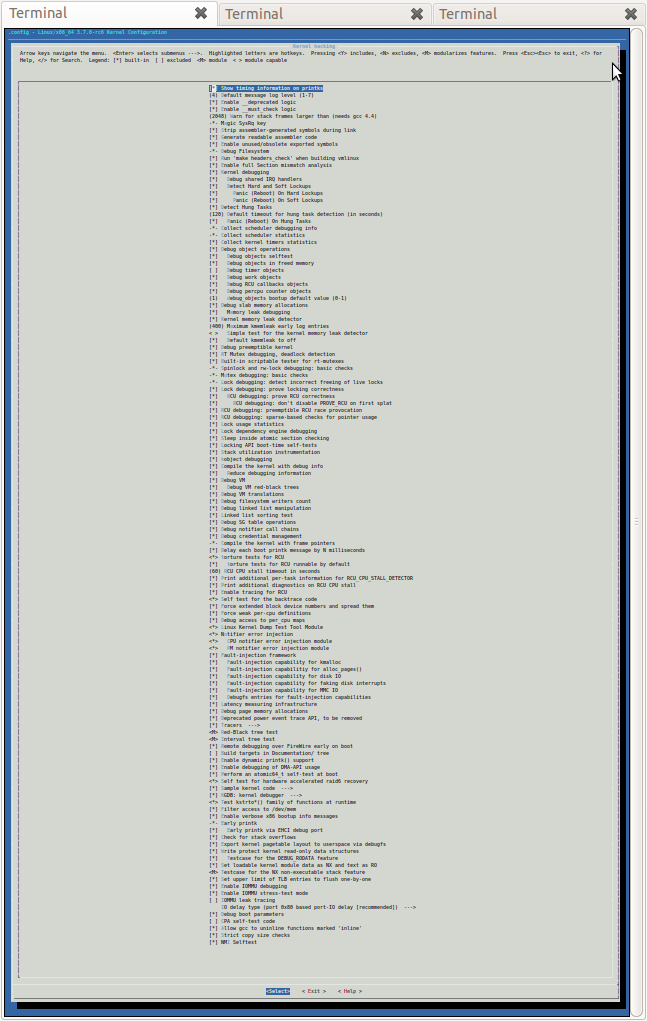
 "I think the "Kernel Hacking" menu has gotten a bit out of hand.  It is
  over 120 lines long on my system with everything enabled and options
  are scattered around it haphazardly.

        http://sr71.net/~dave/linux/kconfig-horror.png

  Let's try to introduce some sanity.  This set takes that 120 lines
  down to 55 and makes it vastly easier to find some things.  It's a
  start.

  This set stands on its own, but there is plenty of room for follow-up
  patches.  The arch-specific debug options still end up getting stuck
  in the top-level "kernel hacking" menu.  OPTIMIZE_INLINING, for
  instance, could obviously go in to the "compiler options" menu, but
  the fact that it is defined in arch/ in a separate Kconfig file keeps
  it on its own for the moment.

  The Signed-off-by's in here look funky.  I changed employers while
  working on this set, so I have signoffs from both email addresses"

* emailed patches from Dave Hansen <dave@sr71.net>:
  hang and lockup detection menu
  kconfig: consolidate printk options
  group locking debugging options
  consolidate compilation option configs
  consolidate runtime testing configs
  order memory debugging Kconfig options
  consolidate per-arch stack overflow debugging options