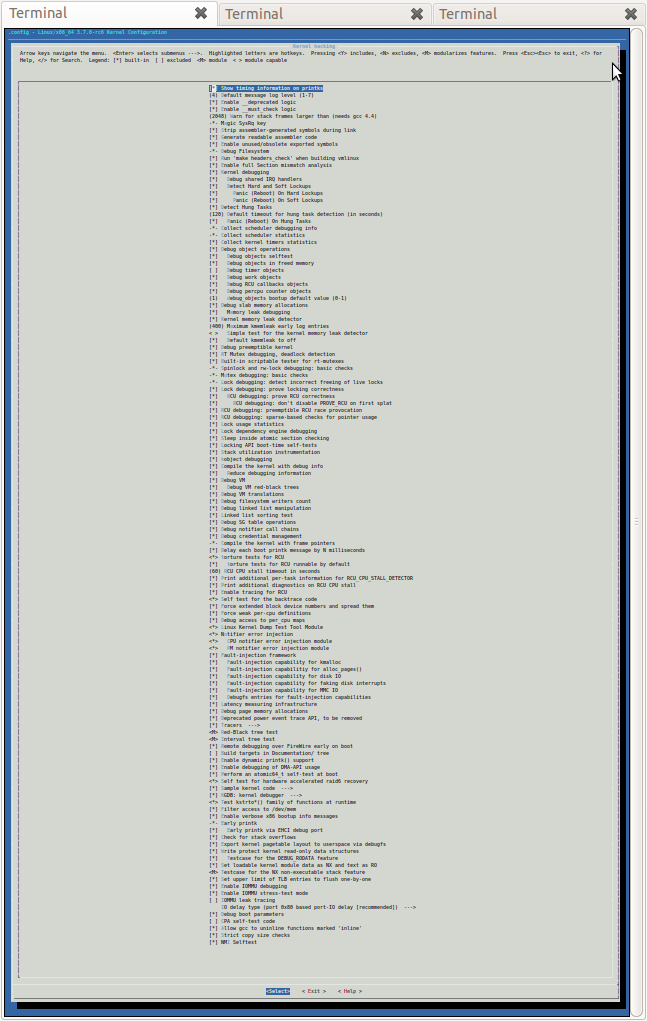
Merge Kconfig menu diet patches from Dave Hansen:
 "I think the "Kernel Hacking" menu has gotten a bit out of hand.  It is
  over 120 lines long on my system with everything enabled and options
  are scattered around it haphazardly.

        http://sr71.net/~dave/linux/kconfig-horror.png

  Let's try to introduce some sanity.  This set takes that 120 lines
  down to 55 and makes it vastly easier to find some things.  It's a
  start.

  This set stands on its own, but there is plenty of room for follow-up
  patches.  The arch-specific debug options still end up getting stuck
  in the top-level "kernel hacking" menu.  OPTIMIZE_INLINING, for
  instance, could obviously go in to the "compiler options" menu, but
  the fact that it is defined in arch/ in a separate Kconfig file keeps
  it on its own for the moment.

  The Signed-off-by's in here look funky.  I changed employers while
  working on this set, so I have signoffs from both email addresses"

* emailed patches from Dave Hansen <dave@sr71.net>:
  hang and lockup detection menu
  kconfig: consolidate printk options
  group locking debugging options
  consolidate compilation option configs
  consolidate runtime testing configs
  order memory debugging Kconfig options
  consolidate per-arch stack overflow debugging options
This patch adds a new udbg early debug console which utilises
statically defined input and output buffers stored within the kernel
BSS. It is primarily designed to assist with bring up of new hardware
which may not have a working console but which has a method of
reading/writing kernel memory.
This version incorporates comments made by Ben H (thanks!).
Changes from v1:
- Add memory barriers.
- Ensure updating of read/write positions is atomic.
Signed-off-by: Alistair Popple <alistair@popple.id.au>
Signed-off-by: Benjamin Herrenschmidt <benh@kernel.crashing.org>
Add the ability to inject IOMMU faults. We enable this per device
via a fail_iommu sysfs property, similar to fault injection on other
subsystems.

An example:

...
0003:01:00.1 Ethernet controller: Emulex Corporation OneConnect 10Gb NIC (be3) (rev 02)

To inject one error to this device:

echo 1 > /sys/bus/pci/devices/0003:01:00.1/fail_iommu
echo 1 > /sys/kernel/debug/fail_iommu/probability
echo 1 > /sys/kernel/debug/fail_iommu/times

As feared, the first failure injected on the be3 results in an
unrecoverable error, taking down both functions of the card
permanently:

be2net 0003:01:00.1: Unrecoverable error in the card

Signed-off-by: Anton Blanchard <anton@samba.org>
Signed-off-by: Benjamin Herrenschmidt <benh@kernel.crashing.org>
The debugfs code is really generic for all platforms.  This patch removes the
powerpc-specific directory reference and makes it available to all
architectures.

Signed-off-by: Grant Likely <grant.likely@secretlab.ca>
After this, we can remove the legacy iSeries code more easily.

Signed-off-by: Stephen Rothwell <sfr@canb.auug.org.au>
Signed-off-by: Benjamin Herrenschmidt <benh@kernel.crashing.org>
As described in the help text in the patch, this token restricts general
access to /dev/mem as a way of increasing the security. Specifically, access
to exclusive IOMEM and kernel RAM is denied unless CONFIG_STRICT_DEVMEM is
set to 'n'.

Implement the 'devmem_is_allowed()' interface for Powerpc. It will be
called from range_is_allowed() when userpsace attempts to access /dev/mem.

This patch is based on an earlier patch from Steve Best and with input from
Paul Mackerras and Scott Wood.

[BenH] Fixed a typo or two and removed the generic change which should
       be submitted as a separate patch

Signed-off-by: Sukadev Bhattiprolu <sukadev@linux.vnet.ibm.com>
Signed-off-by: Benjamin Herrenschmidt <benh@kernel.crashing.org>
This adds a udbg and an hvc console backend for supporting a console
using the OPAL console interfaces.

On OPAL v1 we have hvc0 mapped to whatever console the system was
configured for (network or hvsi serial port) via the service
processor.

On OPAL v2 we have hvcN mapped to the Nth console provided by OPAL
which generally corresponds to:

	hvc0 : network console (raw protocol)
	hvc1 : serial port S1 (hvsi)
	hvc2 : serial port S2 (hvsi)

Note: At this point, early debug console only works with OPAL v1
and shouldn't be enabled in a normal kernel.

Signed-off-by: Benjamin Herrenschmidt <benh@kernel.crashing.org>
It was preventing the global early debug selection whenever KVM was enabled
instead of only preventing the 440 specific one.

Signed-off-by: Benjamin Herrenschmidt <benh@kernel.crashing.org>
Add a new udbg driver for the PS3 gelic Ehthernet device.

This driver shares only a few stucture and constant definitions with the
gelic Ethernet device driver, so is implemented as a stand-alone driver
with no dependencies on the gelic Ethernet device driver.

Signed-off-by: Hector Martin <hector@marcansoft.com>
Signed-off-by: Andre Heider <a.heider@gmail.com>
Signed-off-by: Geoff Levand <geoff@infradead.org>
Signed-off-by: Benjamin Herrenschmidt <benh@kernel.crashing.org>
On pseries machines, consoles are provided by the hypervisor using
a low level get_chars/put_chars type interface. However, this is
really just a transport to the service processor which implements
them either as "raw" console (networked consoles, HMC, ...) or as
"hvsi" serial ports.

The later is a simple packet protocol on top of the raw character
interface that is supposed to convey additional "serial port" style
semantics. In practice however, all it does is provide a way to
read the CD line and set/clear our DTR line, that's it.

We currently implement the "raw" protocol as an hvc console backend
(/dev/hvcN) and the "hvsi" protocol using a separate tty driver
(/dev/hvsi0).

However this is quite impractical. The arbitrary difference between
the two type of devices has been a major source of user (and distro)
confusion. Additionally, there's an additional mini -hvsi implementation
in the pseries platform code for our low level debug console and early
boot kernel messages, which means code duplication, though that low
level variant is impractical as it's incapable of doing the initial
protocol negociation to establish the link to the FSP.

This essentially replaces the dedicated hvsi driver and the platform
udbg code completely by extending the existing hvc_vio backend used
in "raw" mode so that:

 - It now supports HVSI as well
 - We add support for hvc backend providing tiocm{get,set}
 - It also provides a udbg interface for early debug and boot console

This is overall less code, though this will only be obvious once we
remove the old "hvsi" driver, which is still available for now. When
the old driver is enabled, the new code still kicks in for the low
level udbg console, replacing the old mini implementation in the platform
code, it just doesn't provide the higher level "hvc" interface.

In addition to producing generally simler code, this has several benefits
over our current situation:

 - The user/distro only has to deal with /dev/hvcN for the hypervisor
console, avoiding all sort of confusion that has plagued us in the past

 - The tty, kernel and low level debug console all use the same code
base which supports the full protocol establishment process, thus the
console is now available much earlier than it used to be with the
old HVSI driver. The kernel console works much earlier and udbg is
available much earlier too. Hackers can enable a hard coded very-early
debug console as well that works with HVSI (previously that was only
supported for the "raw" mode).

I've tried to keep the same semantics as hvsi relative to how I react
to things like CD changes, with some subtle differences though:

 - I clear DTR on close if HUPCL is set

 - Current hvsi triggers a hangup if it detects a up->down transition
   on CD (you can still open a console with CD down). My new implementation
   triggers a hangup if the link to the FSP is severed, and severs it upon
   detecting a up->down transition on CD.

Signed-off-by: Benjamin Herrenschmidt <benh@kernel.crashing.org>
Irq stacks provide an essential protection from stack overflows through
external interrupts, at the cost of two additionals stacks per CPU.

Enable them unconditionally to simplify the kernel build and prevent
people from accidentally disabling them.

Signed-off-by: Christoph Hellwig <hch@lst.de>
Signed-off-by: Benjamin Herrenschmidt <benh@kernel.crashing.org>
Enable the DEBUG_PER_CPU_MAPS option so we can look for problems with
cpumasks .

Signed-off-by: Anton Blanchard <anton@samba.org>
Signed-off-by: Benjamin Herrenschmidt <benh@kernel.crashing.org>
* 'next' of git://git.secretlab.ca/git/linux-2.6: (23 commits)
  powerpc: fix up for mmu_mapin_ram api change
  powerpc: wii: allow ioremap within the memory hole
  powerpc: allow ioremap within reserved memory regions
  wii: use both mem1 and mem2 as ram
  wii: bootwrapper: add fixup to calc useable mem2
  powerpc: gamecube/wii: early debugging using usbgecko
  powerpc: reserve fixmap entries for early debug
  powerpc: wii: default config
  powerpc: wii: platform support
  powerpc: wii: hollywood interrupt controller support
  powerpc: broadway processor support
  powerpc: wii: bootwrapper bits
  powerpc: wii: device tree
  powerpc: gamecube: default config
  powerpc: gamecube: platform support
  powerpc: gamecube/wii: flipper interrupt controller support
  powerpc: gamecube/wii: udbg support for usbgecko
  powerpc: gamecube/wii: do not include PCI support
  powerpc: gamecube/wii: declare as non-coherent platforms
  powerpc: gamecube/wii: introduce GAMECUBE_COMMON
  ...

Fix up conflicts in arch/powerpc/mm/fsl_booke_mmu.c.

Hopefully even close to correctly.
Add support for using the USB Gecko adapter as an early debugging
console on the Nintendo GameCube and Wii video game consoles.
The USB Gecko is a 3rd party memory card interface adapter that provides
a EXI (External Interface) to USB serial converter.

Signed-off-by: Albert Herranz <albert_herranz@yahoo.es>
Acked-by: Benjamin Herrenschmidt <benh@kernel.crashing.org>
Signed-off-by: Grant Likely <grant.likely@secretlab.ca>
Add hcall_entry and hcall_exit tracepoints.  This replaces the inline
assembly HCALL_STATS code and converts it to use the new tracepoints.

To keep the disabled case as quick as possible, we embed a status word
in the TOC so we can get at it with a single load.  By doing so we
keep the overhead at a minimum.  Time taken for a null hcall:

No tracepoint code:	135.79 cycles
Disabled tracepoints:	137.95 cycles

For reference, before this patch enabling HCALL_STATS resulted in a null
hcall of 201.44 cycles!

Signed-off-by: Anton Blanchard <anton@samba.org>
Signed-off-by: Paul Mackerras <paulus@samba.org>
Add the option to build the code under arch/powerpc with -Werror.

The intention is to make it harder for people to inadvertantly introduce
warnings in the arch/powerpc code. It needs to be configurable so that
if a warning is introduced, people can easily work around it while it's
being fixed.

The option is a negative, ie. don't enable -Werror, so that it will be
turned on for allyes and allmodconfig builds.

The default is n, in the hope that developers will build with -Werror,
that will probably lead to some build breaks, I am prepared to be flamed.

It's not enabled for math-emu, which is a steaming pile of warnings.

Signed-off-by: Michael Ellerman <michael@ellerman.id.au>
Signed-off-by: Benjamin Herrenschmidt <benh@kernel.crashing.org>
If CONFIG_PPC_EMULATED_STATS is enabled, make available counters for the
various classes of emulated instructions under
/sys/kernel/debug/powerpc/emulated_instructions/ (assumed debugfs is mounted on
/sys/kernel/debug).  Optionally (controlled by
/sys/kernel/debug/powerpc/emulated_instructions/do_warn), rate-limited warnings
can be printed to the console when instructions are emulated.

Signed-off-by: Geert Uytterhoeven <Geert.Uytterhoeven@sonycom.com>
Signed-off-by: Benjamin Herrenschmidt <benh@kernel.crashing.org>
This fixes a build failure with generic debug pagealloc:

  mm/debug-pagealloc.c: In function 'set_page_poison':
  mm/debug-pagealloc.c:8: error: 'struct page' has no member named 'debug_flags'
  mm/debug-pagealloc.c: In function 'clear_page_poison':
  mm/debug-pagealloc.c:13: error: 'struct page' has no member named 'debug_flags'
  mm/debug-pagealloc.c: In function 'page_poison':
  mm/debug-pagealloc.c:18: error: 'struct page' has no member named 'debug_flags'
  mm/debug-pagealloc.c: At top level:
  mm/debug-pagealloc.c:120: error: redefinition of 'kernel_map_pages'
  include/linux/mm.h:1278: error: previous definition of 'kernel_map_pages' was here
  mm/debug-pagealloc.c: In function 'kernel_map_pages':
  mm/debug-pagealloc.c:122: error: 'debug_pagealloc_enabled' undeclared (first use in this function)

by fixing

 - debug_flags should be in struct page
 - define DEBUG_PAGEALLOC config option for all architectures

Signed-off-by: Akinobu Mita <akinobu.mita@gmail.com>
Reported-by: Alexander Beregalov <a.beregalov@gmail.com>
Signed-off-by: Andrew Morton <akpm@linux-foundation.org>
Signed-off-by: Linus Torvalds <torvalds@linux-foundation.org>
CONFIG_DEBUG_PAGEALLOC is now supported by x86, powerpc, sparc64, and
s390.  This patch implements it for the rest of the architectures by
filling the pages with poison byte patterns after free_pages() and
verifying the poison patterns before alloc_pages().

This generic one cannot detect invalid page accesses immediately but
invalid read access may cause invalid dereference by poisoned memory and
invalid write access can be detected after a long delay.

Signed-off-by: Akinobu Mita <akinobu.mita@gmail.com>
Cc: <linux-arch@vger.kernel.org>
Signed-off-by: Andrew Morton <akpm@linux-foundation.org>
Signed-off-by: Linus Torvalds <torvalds@linux-foundation.org>
CONFIG_PPC_MULTIPLATFORM is a remain of the pre-powerpc days and isn't
really meaningful anymore. It was basically equivalent to PPC64 || 6xx.

This removes it along with the following changes:

 - 32-bit platforms that relied on PPC32 && PPC_MULTIPLATFORM now rely
   on 6xx which is what they want anyway.

 - A new symbol, PPC_BOOK3S, is defined that represent compliance with
   the "Server" variant of the architecture. This is set when either 6xx
   or PPC64 is set and open the door for future BOOK3E 64-bit.

 - 64-bit platforms that relied on PPC64 && PPC_MULTIPLATFORM now use
   PPC64 && PPC_BOOK3S

 - A separate and selectable CONFIG_PPC_OF_BOOT_TRAMPOLINE option is now
   used to control the use of prom_init.c

Signed-off-by: Benjamin Herrenschmidt <benh@kernel.crashing.org>