This is very useful for debugging issues with the recently added
pagetable switching code for EFI virtual mode.

Signed-off-by: Borislav Petkov <bp@suse.de>
Tested-by: Toshi Kani <toshi.kani@hp.com>
Signed-off-by: Matt Fleming <matt.fleming@intel.com>
It can take some time to validate the image, make sure
{allyes|allmod}config doesn't enable it.

I'd say randconfig will cover it often enough, and the failure is also
borderline build coverage related: you cannot really make the decoder
test fail via source level changes, only with changes in the build
environment, so I agree with Andi that we can disable this one too.

Signed-off-by: Ingo Molnar <mingo@kernel.org>
Acked-by: Paul Gortmaker paul.gortmaker@windriver.com>
Suggested-and-acked-by: Andi Kleen andi@firstfloor.org>
Signed-off-by: Linus Torvalds <torvalds@linux-foundation.org>
It's incredibly difficult to diagnose early EFI boot issues without
special hardware because earlyprintk=vga doesn't work on EFI systems.

Add support for writing to the EFI framebuffer, via earlyprintk=efi,
which will actually give users a chance of providing debug output.

Cc: H. Peter Anvin <hpa@zytor.com>
Acked-by: Ingo Molnar <mingo@kernel.org>
Cc: Thomas Gleixner <tglx@linutronix.de>
Cc: Peter Jones <pjones@redhat.com>
Signed-off-by: Matt Fleming <matt.fleming@intel.com>
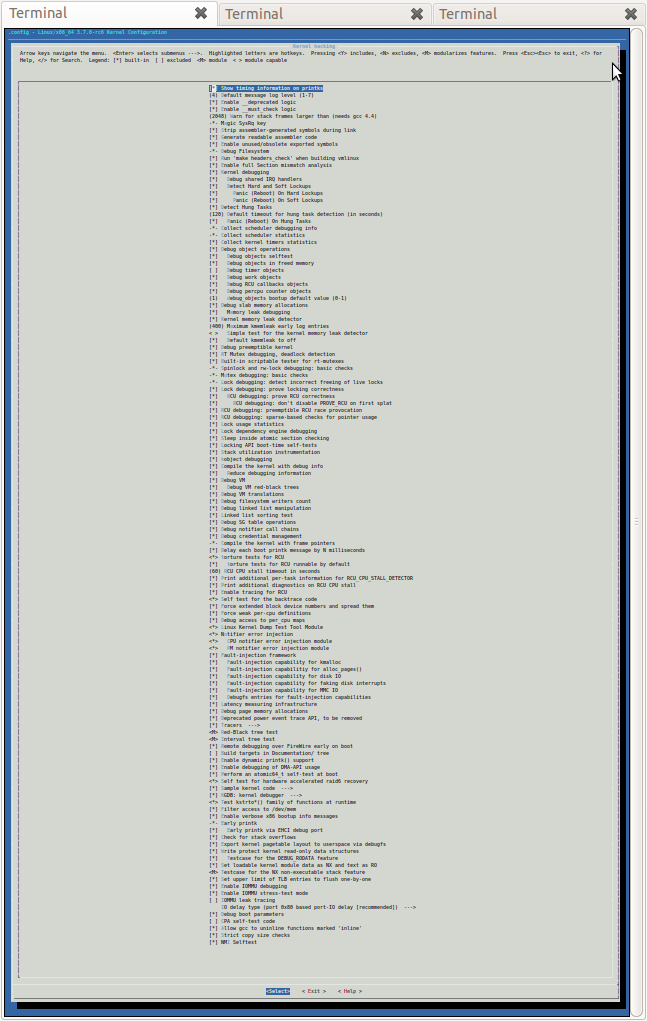
Merge Kconfig menu diet patches from Dave Hansen:
 "I think the "Kernel Hacking" menu has gotten a bit out of hand.  It is
  over 120 lines long on my system with everything enabled and options
  are scattered around it haphazardly.

        http://sr71.net/~dave/linux/kconfig-horror.png

  Let's try to introduce some sanity.  This set takes that 120 lines
  down to 55 and makes it vastly easier to find some things.  It's a
  start.

  This set stands on its own, but there is plenty of room for follow-up
  patches.  The arch-specific debug options still end up getting stuck
  in the top-level "kernel hacking" menu.  OPTIMIZE_INLINING, for
  instance, could obviously go in to the "compiler options" menu, but
  the fact that it is defined in arch/ in a separate Kconfig file keeps
  it on its own for the moment.

  The Signed-off-by's in here look funky.  I changed employers while
  working on this set, so I have signoffs from both email addresses"

* emailed patches from Dave Hansen <dave@sr71.net>:
  hang and lockup detection menu
  kconfig: consolidate printk options
  group locking debugging options
  consolidate compilation option configs
  consolidate runtime testing configs
  order memory debugging Kconfig options
  consolidate per-arch stack overflow debugging options
Pull x86 FPU changes from Ingo Molnar:
 "There are two bigger changes in this tree:

   - Add an [early-use-]safe static_cpu_has() variant and other
     robustness improvements, including the new X86_DEBUG_STATIC_CPU_HAS
     configurable debugging facility, motivated by recent obscure FPU
     code bugs, by Borislav Petkov

   - Reimplement FPU detection code in C and drop the old asm code, by
     Peter Anvin."

* 'x86-fpu-for-linus' of git://git.kernel.org/pub/scm/linux/kernel/git/tip/tip:
  x86, fpu: Use static_cpu_has_safe before alternatives
  x86: Add a static_cpu_has_safe variant
  x86: Sanity-check static_cpu_has usage
  x86, cpu: Add a synthetic, always true, cpu feature
  x86: Get rid of ->hard_math and all the FPU asm fu
static_cpu_has may be used only after alternatives have run. Before that
it always returns false if constant folding with __builtin_constant_p()
doesn't happen. And you don't want that.

This patch is the result of me debugging an issue where I overzealously
put static_cpu_has in code which executed before alternatives have run
and had to spend some time with scratching head and cursing at the
monitor.

So add a jump to a warning which screams loudly when we use this
function too early. The alternatives patch that check away in
conjunction with patching the rest of the kernel image.

[ hpa: factored this into its own configuration option.  If we want to
  have an overarching option, it should be an option which selects
  other options, not as a group option in the source code. ]

Signed-off-by: Borislav Petkov <bp@suse.de>
Link: http://lkml.kernel.org/r/1370772454-6106-4-git-send-email-bp@alien8.de
Signed-off-by: H. Peter Anvin <hpa@linux.intel.com>
It is sometimes very helpful to be able to pinpoint the location which
causes a double fault before it turns into a triple fault and the
machine reboots. We have this for 32-bit already so extend it to 64-bit.
On 64-bit we get the register snapshot at #DF time and not from the
first exception which actually causes the #DF. It should be close
enough, though.

[ hpa: and definitely better than nothing, which is what we have now. ]

Signed-off-by: Borislav Petkov <bp@suse.de>
Link: http://lkml.kernel.org/r/1368093749-31296-1-git-send-email-bp@alien8.de
Signed-off-by: H. Peter Anvin <hpa@linux.intel.com>
The help text for this config is duplicated across the x86, parisc, and
s390 Kconfig.debug files.  Arnd Bergman noted that the help text was
slightly misleading and should be fixed to state that enabling this
option isn't a problem when using pre 4.4 gcc.

To simplify the rewording, consolidate the text into lib/Kconfig.debug
and modify it there to be more explicit about when you should say N to
this config.

Also, make the text a bit more generic by stating that this option
enables compile time checks so we can cover architectures which emit
warnings vs.  ones which emit errors.  The details of how an
architecture decided to implement the checks isn't as important as the
concept of compile time checking of copy_from_user() calls.

While we're doing this, remove all the copy_from_user_overflow() code
that's duplicated many times and place it into lib/ so that any
architecture supporting this option can get the function for free.

Signed-off-by: Stephen Boyd <sboyd@codeaurora.org>
Acked-by: Arnd Bergmann <arnd@arndb.de>
Acked-by: Ingo Molnar <mingo@kernel.org>
Acked-by: H. Peter Anvin <hpa@zytor.com>
Cc: Arjan van de Ven <arjan@linux.intel.com>
Acked-by: Helge Deller <deller@gmx.de>
Cc: Heiko Carstens <heiko.carstens@de.ibm.com>
Cc: Stephen Rothwell <sfr@canb.auug.org.au>
Cc: Chris Metcalf <cmetcalf@tilera.com>
Signed-off-by: Andrew Morton <akpm@linux-foundation.org>
Signed-off-by: Linus Torvalds <torvalds@linux-foundation.org>
CONFIG_INVLPG got removed in commit
094ab1db7c ("x86, 386 removal:
Remove CONFIG_INVLPG").

That commit left one instance of CONFIG_INVLPG untouched, effectively
disabling DEBUG_TLBFLUSH for X86_32. Since all currently supported
x86 CPUs should now be able to support that option, just drop the entire
sub-dependency.

Signed-off-by: Paul Bolle <pebolle@tiscali.nl>
Link: http://lkml.kernel.org/r/1363262077.1335.71.camel@x61.thuisdomein
Signed-off-by: Ingo Molnar <mingo@kernel.org>
kernel will replace cr3 rewrite with invlpg when
  tlb_flush_entries <= active_tlb_entries / 2^tlb_flushall_factor
if tlb_flushall_factor is -1, kernel won't do this replacement.

User can modify its value according to specific CPU/applications.

Thanks for Borislav providing the help message of
CONFIG_DEBUG_TLBFLUSH.

Signed-off-by: Alex Shi <alex.shi@intel.com>
Link: http://lkml.kernel.org/r/1340845344-27557-6-git-send-email-alex.shi@intel.com
Signed-off-by: H. Peter Anvin <hpa@zytor.com>
* 'x86-platform-for-linus' of git://git.kernel.org/pub/scm/linux/kernel/git/tip/tip:
  x86/intel config: Fix the APB_TIMER selection
  x86/mrst: Add additional debug prints for pb_keys
  x86/intel config: Revamp configuration to allow for Moorestown and Medfield
  x86/intel/scu/ipc: Match the changes in the x86 configuration
  x86/apb: Fix configuration constraints
  x86: Fix INTEL_MID silly
  x86/Kconfig: Cyclone-timer depends on x86-summit
  x86: Reduce clock calibration time during slave cpu startup
  x86/config: Revamp configuration for MID devices
  x86/sfi: Kill the IRQ as id hack
This follows on from the patch applied in 3.2rc1 which creates
an INTEL_MID configuration. We can now add the entry for
Medfield specific code. After this is merged the final patch
will be submitted which moves the rest of the device Kconfig
dependancies to MRST/MEDFIELD/INTEL_MID as appropriate.

Signed-off-by: Alan Cox <alan@linux.intel.com>
Signed-off-by: Ingo Molnar <mingo@elte.hu>
There are numerous broken references to Documentation files (in other
Documentation files, in comments, etc.). These broken references are
caused by typo's in the references, and by renames or removals of the
Documentation files. Some broken references are simply odd.

Fix these broken references, sometimes by dropping the irrelevant text
they were part of.

Signed-off-by: Paul Bolle <pebolle@tiscali.nl>
Signed-off-by: Jiri Kosina <jkosina@suse.cz>
The meaning of CONFIG_EMBEDDED has long since been obsoleted; the option
is used to configure any non-standard kernel with a much larger scope than
only small devices.

This patch renames the option to CONFIG_EXPERT in init/Kconfig and fixes
references to the option throughout the kernel.  A new CONFIG_EMBEDDED
option is added that automatically selects CONFIG_EXPERT when enabled and
can be used in the future to isolate options that should only be
considered for embedded systems (RISC architectures, SLOB, etc).

Calling the option "EXPERT" more accurately represents its intention: only
expert users who understand the impact of the configuration changes they
are making should enable it.

Reviewed-by: Ingo Molnar <mingo@elte.hu>
Acked-by: David Woodhouse <david.woodhouse@intel.com>
Signed-off-by: David Rientjes <rientjes@google.com>
Cc: Greg KH <gregkh@suse.de>
Cc: "David S. Miller" <davem@davemloft.net>
Cc: Jens Axboe <axboe@kernel.dk>
Cc: Arnd Bergmann <arnd@arndb.de>
Cc: Robin Holt <holt@sgi.com>
Cc: <linux-arch@vger.kernel.org>
Signed-off-by: Andrew Morton <akpm@linux-foundation.org>
Signed-off-by: Linus Torvalds <torvalds@linux-foundation.org>
This patch is a logical extension of the protection provided by
CONFIG_DEBUG_RODATA to LKMs. The protection is provided by
splitting module_core and module_init into three logical parts
each and setting appropriate page access permissions for each
individual section:

 1. Code: RO+X
 2. RO data: RO+NX
 3. RW data: RW+NX

In order to achieve proper protection, layout_sections() have
been modified to align each of the three parts mentioned above
onto page boundary. Next, the corresponding page access
permissions are set right before successful exit from
load_module(). Further, free_module() and sys_init_module have
been modified to set module_core and module_init as RW+NX right
before calling module_free().

By default, the original section layout and access flags are
preserved. When compiled with CONFIG_DEBUG_SET_MODULE_RONX=y,
the patch will page-align each group of sections to ensure that
each page contains only one type of content and will enforce
RO/NX for each group of pages.

  -v1: Initial proof-of-concept patch.
  -v2: The patch have been re-written to reduce the number of #ifdefs
       and to make it architecture-agnostic. Code formatting has also
       been corrected.
  -v3: Opportunistic RO/NX protection is now unconditional. Section
       page-alignment is enabled when CONFIG_DEBUG_RODATA=y.
  -v4: Removed most macros and improved coding style.
  -v5: Changed page-alignment and RO/NX section size calculation
  -v6: Fixed comments. Restricted RO/NX enforcement to x86 only
  -v7: Introduced CONFIG_DEBUG_SET_MODULE_RONX, added
       calls to set_all_modules_text_rw() and set_all_modules_text_ro()
       in ftrace
  -v8: updated for compatibility with linux 2.6.33-rc5
  -v9: coding style fixes
 -v10: more coding style fixes
 -v11: minor adjustments for -tip
 -v12: minor adjustments for v2.6.35-rc2-tip
 -v13: minor adjustments for v2.6.37-rc1-tip

Signed-off-by: Siarhei Liakh <sliakh.lkml@gmail.com>
Signed-off-by: Xuxian Jiang <jiang@cs.ncsu.edu>
Acked-by: Arjan van de Ven <arjan@linux.intel.com>
Reviewed-by: James Morris <jmorris@namei.org>
Signed-off-by: H. Peter Anvin <hpa@zytor.com>
Cc: Andi Kleen <ak@muc.de>
Cc: Rusty Russell <rusty@rustcorp.com.au>
Cc: Stephen Rothwell <sfr@canb.auug.org.au>
Cc: Dave Jones <davej@redhat.com>
Cc: Kees Cook <kees.cook@canonical.com>
Cc: Linus Torvalds <torvalds@linux-foundation.org>
LKML-Reference: <4CE2F914.9070106@free.fr>
[ minor cleanliness edits, -v14: build failure fix ]
Signed-off-by: Ingo Molnar <mingo@elte.hu>
Intel Moorestown platform has a spi-uart device(Maxim3110),
which connects to a Designware spi core controller. This patch
will add early console function based on it.

As it will be used long before Linux spi subsystem get
initialised, we simply directly manipulate the spi controller's
register to acheive the early console func. This is safe as it
will be disabled when devices subsytem get initialised.

To use it, user need enable CONFIG_X86_MRST_EARLY_PRINTK in
kenrel config and add "earlyprintk=mrst" in kernel command line.

Signed-off-by: Feng Tang <feng.tang@intel.com>
Acked-by: Alan Cox <alan@linux.intel.com>
Cc: greg@kroah.com
LKML-Reference: <1284361736-23011-4-git-send-email-feng.tang@intel.com>
Signed-off-by: Ingo Molnar <mingo@elte.hu>
These days 4 kilobytes of stack just aren't enough for reliably operation,
and people using lots of threads have long switched to 64-bit kernels, so
remove the CONFIG_4KSTACKS option.

Signed-off-by: Christoph Hellwig <hch@lst.de>
LKML-Reference: <20100628121614.GB6605@lst.de>
Signed-off-by: Thomas Gleixner <tglx@linutronix.de>
IRQ stacks provide much better safety against unexpected stack use from
interrupts, at the minimal downside of slightly higher memory usage.
Enable irq stacks also for the default 8k stack on 32-bit kernels to
minimize the problem of stack overflows through interrupt activity.

This is what the 64-bit kernel and various other architectures already do.

Signed-off-by: Christoph Hellwig <hch@lst.de>
LKML-Reference: <20100628121554.GA6605@lst.de>
Signed-off-by: Thomas Gleixner <tglx@linutronix.de>
 Borislav Petkov
 Ingo Molnar
 Matt Fleming
 Linus Torvalds
 Dave Hansen
 Stephen Boyd
 Paul Bolle
 Alex Shi
 Don Zickus
 Alan Cox
 Mitsuo Hayasaka
 David Rientjes
 matthieu castet
 Feng Tang
 Christoph Hellwig