I wanted to know the hottest path through a function and figured the
branch-stack (LBR) information should be able to help out with that.

The below uses the branch-stack to create basic blocks and generate
statistics from them.

        from    to              branch_i
        * ----> *
                |
                | block
                v
                * ----> *
                from    to      branch_i+1

The blocks are broken down into non-overlapping ranges, while tracking
if the start of each range is an entry point and/or the end of a range
is a branch.

Each block iterates all ranges it covers (while splitting where required
to exactly match the block) and increments the 'coverage' count.

For the range including the branch we increment the taken counter, as
well as the pred counter if flags.predicted.

Using these number we can find if an instruction:

 - had coverage; given by:

        br->coverage / br->sym->max_coverage

   This metric ensures each symbol has a 100% spot, which reflects the
   observation that each symbol must have a most covered/hottest
   block.

 - is a branch target: br->is_target && br->start == add

 - for targets, how much of a branch's coverages comes from it:

	target->entry / branch->coverage

 - is a branch: br->is_branch && br->end == addr

 - for branches, how often it was taken:

        br->taken / br->coverage

   after all, all execution that didn't take the branch would have
   incremented the coverage and continued onward to a later branch.

 - for branches, how often it was predicted:

        br->pred / br->taken

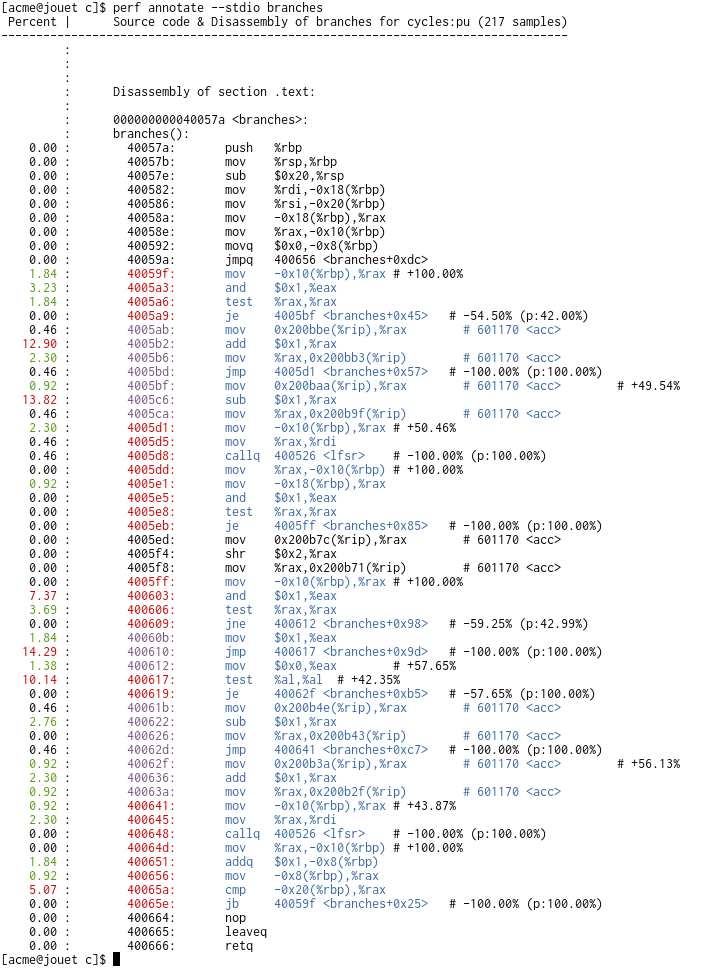
The coverage percentage is used to color the address and asm sections;
for low (<1%) coverage we use NORMAL (uncolored), indicating that these
instructions are not 'important'. For high coverage (>75%) we color the
address RED.

For each branch, we add an asm comment after the instruction with
information on how often it was taken and predicted.

Output looks like (sans color, which does loose a lot of the
information :/)

$ perf record --branch-filter u,any -e cycles:p ./branches 27
$ perf annotate branches

 Percent |	Source code & Disassembly of branches for cycles:pu (217 samples)
---------------------------------------------------------------------------------
         :	branches():
    0.00 :	  40057a:       push   %rbp
    0.00 :	  40057b:       mov    %rsp,%rbp
    0.00 :	  40057e:       sub    $0x20,%rsp
    0.00 :	  400582:       mov    %rdi,-0x18(%rbp)
    0.00 :	  400586:       mov    %rsi,-0x20(%rbp)
    0.00 :	  40058a:       mov    -0x18(%rbp),%rax
    0.00 :	  40058e:       mov    %rax,-0x10(%rbp)
    0.00 :	  400592:       movq   $0x0,-0x8(%rbp)
    0.00 :	  40059a:       jmpq   400656 <branches+0xdc>
    1.84 :	  40059f:       mov    -0x10(%rbp),%rax	# +100.00%
    3.23 :	  4005a3:       and    $0x1,%eax
    1.84 :	  4005a6:       test   %rax,%rax
    0.00 :	  4005a9:       je     4005bf <branches+0x45>	# -54.50% (p:42.00%)
    0.46 :	  4005ab:       mov    0x200bbe(%rip),%rax        # 601170 <acc>
   12.90 :	  4005b2:       add    $0x1,%rax
    2.30 :	  4005b6:       mov    %rax,0x200bb3(%rip)        # 601170 <acc>
    0.46 :	  4005bd:       jmp    4005d1 <branches+0x57>	# -100.00% (p:100.00%)
    0.92 :	  4005bf:       mov    0x200baa(%rip),%rax        # 601170 <acc>	# +49.54%
   13.82 :	  4005c6:       sub    $0x1,%rax
    0.46 :	  4005ca:       mov    %rax,0x200b9f(%rip)        # 601170 <acc>
    2.30 :	  4005d1:       mov    -0x10(%rbp),%rax	# +50.46%
    0.46 :	  4005d5:       mov    %rax,%rdi
    0.46 :	  4005d8:       callq  400526 <lfsr>	# -100.00% (p:100.00%)
    0.00 :	  4005dd:       mov    %rax,-0x10(%rbp)	# +100.00%
    0.92 :	  4005e1:       mov    -0x18(%rbp),%rax
    0.00 :	  4005e5:       and    $0x1,%eax
    0.00 :	  4005e8:       test   %rax,%rax
    0.00 :	  4005eb:       je     4005ff <branches+0x85>	# -100.00% (p:100.00%)
    0.00 :	  4005ed:       mov    0x200b7c(%rip),%rax        # 601170 <acc>
    0.00 :	  4005f4:       shr    $0x2,%rax
    0.00 :	  4005f8:       mov    %rax,0x200b71(%rip)        # 601170 <acc>
    0.00 :	  4005ff:       mov    -0x10(%rbp),%rax	# +100.00%
    7.37 :	  400603:       and    $0x1,%eax
    3.69 :	  400606:       test   %rax,%rax
    0.00 :	  400609:       jne    400612 <branches+0x98>	# -59.25% (p:42.99%)
    1.84 :	  40060b:       mov    $0x1,%eax
   14.29 :	  400610:       jmp    400617 <branches+0x9d>	# -100.00% (p:100.00%)
    1.38 :	  400612:       mov    $0x0,%eax	# +57.65%
   10.14 :	  400617:       test   %al,%al	# +42.35%
    0.00 :	  400619:       je     40062f <branches+0xb5>	# -57.65% (p:100.00%)
    0.46 :	  40061b:       mov    0x200b4e(%rip),%rax        # 601170 <acc>
    2.76 :	  400622:       sub    $0x1,%rax
    0.00 :	  400626:       mov    %rax,0x200b43(%rip)        # 601170 <acc>
    0.46 :	  40062d:       jmp    400641 <branches+0xc7>	# -100.00% (p:100.00%)
    0.92 :	  40062f:       mov    0x200b3a(%rip),%rax        # 601170 <acc>	# +56.13%
    2.30 :	  400636:       add    $0x1,%rax
    0.92 :	  40063a:       mov    %rax,0x200b2f(%rip)        # 601170 <acc>
    0.92 :	  400641:       mov    -0x10(%rbp),%rax	# +43.87%
    2.30 :	  400645:       mov    %rax,%rdi
    0.00 :	  400648:       callq  400526 <lfsr>	# -100.00% (p:100.00%)
    0.00 :	  40064d:       mov    %rax,-0x10(%rbp)	# +100.00%
    1.84 :	  400651:       addq   $0x1,-0x8(%rbp)
    0.92 :	  400656:       mov    -0x8(%rbp),%rax
    5.07 :	  40065a:       cmp    -0x20(%rbp),%rax
    0.00 :	  40065e:       jb     40059f <branches+0x25>	# -100.00% (p:100.00%)
    0.00 :	  400664:       nop
    0.00 :	  400665:       leaveq
    0.00 :	  400666:       retq

(Note: the --branch-filter u,any was used to avoid spurious target and
branch points due to interrupts/faults, they show up as very small -/+
annotations on 'weird' locations)

Committer note:

Please take a look at:

  http://vger.kernel.org/~acme/perf/annotate_basic_blocks.png

To see the colors.

Signed-off-by: Peter Zijlstra (Intel) <peterz@infradead.org>
Tested-by: Arnaldo Carvalho de Melo <acme@redhat.com>
Cc: Alexander Shishkin <alexander.shishkin@linux.intel.com>
Cc: Andi Kleen <andi@firstfloor.org>
Cc: Anshuman Khandual <khandual@linux.vnet.ibm.com>
Cc: David Carrillo-Cisneros <davidcc@google.com>
Cc: Jiri Olsa <jolsa@kernel.org>
Cc: Kan Liang <kan.liang@intel.com>
Cc: Linus Torvalds <torvalds@linux-foundation.org>
Cc: Namhyung Kim <namhyung@kernel.org>
Cc: Stephane Eranian <eranian@google.com>
[ Moved sym->max_coverage to 'struct annotate', aka symbol__annotate(sym) ]
Signed-off-by: Arnaldo Carvalho de Melo <acme@redhat.com>
The 'annotate' tool does some filtering in the entries in a DSO but
forgot to reset the cache done in dso__find_symbol(), cauxing a SEGV:

  [root@zoo ~]# perf annotate netlink_poll
  perf: Segmentation fault
  -------- backtrace --------
  perf[0x526ceb]
  /lib64/libc.so.6(+0x34960)[0x7faedfbe0960]
  perf(rb_erase+0x223)[0x499d63]
  perf[0x4213e9]
  perf[0x4bc123]
  perf[0x4bc621]
  perf[0x4bf26b]
  perf[0x4bc855]
  perf(perf_session__process_events+0x340)[0x4bddc0]
  perf(cmd_annotate+0x6bb)[0x421b5b]
  perf[0x479063]
  perf(main+0x60a)[0x42098a]
  /lib64/libc.so.6(__libc_start_main+0xf0)[0x7faedfbcbfe0]
  perf[0x420aa9]
  [0x0]
  [root@zoo ~]#

Fix it by reseting the find cache when removing symbols.

Cc: Adrian Hunter <adrian.hunter@intel.com>
Cc: Borislav Petkov <bp@suse.de>
Cc: David Ahern <dsahern@gmail.com>
Cc: Frederic Weisbecker <fweisbec@gmail.com>
Cc: Jiri Olsa <jolsa@redhat.com>
Cc: Namhyung Kim <namhyung@kernel.org>
Cc: Stephane Eranian <eranian@google.com>
Fixes: b685ac22b4 ("perf symbols: Add front end cache for DSO symbol lookup")
Link: http://lkml.kernel.org/n/tip-b2y9x46y0t8yem1ive41zqyp@git.kernel.org
Signed-off-by: Arnaldo Carvalho de Melo <acme@redhat.com>
This adds the basic infrastructure to keep track of cycle counts per
basic block for annotate. We allocate an array similar to the normal
accounting, and then account branch cycles there.

We handle two cases:

cycles per basic block with start and cycles per branch (these are later
used for either IPC or just cycles per BB)

In the start case we cannot handle overlaps, so always the longest basic
block wins.

For the cycles per branch case everything is accurately accounted.

v2: Remove unnecessary checks. Slight restructure. Move
symbol__get_annotation to another patch. Move histogram allocation.
v3: Merged with current tree

Signed-off-by: Andi Kleen <ak@linux.intel.com>
Acked-by: Jiri Olsa <jolsa@kernel.org>
Cc: Namhyung Kim <namhyung@kernel.org>
Link: http://lkml.kernel.org/r/1437233094-12844-4-git-send-email-andi@firstfloor.org
Signed-off-by: Arnaldo Carvalho de Melo <acme@redhat.com>
In addition to using refcounts for the struct thread lifetime
management, we need to protect access to machine->threads from
concurrent access.

That happens in 'perf top', where a thread processes events, inserting
and deleting entries from that rb_tree while another thread decays
hist_entries, that end up dropping references and ultimately deleting
threads from the rb_tree and releasing its resources when no further
hist_entry (or other data structures, like in 'perf sched') references
it.

So the rule is the same for refcounts + protected trees in the kernel,
get the tree lock, find object, bump the refcount, drop the tree lock,
return, use object, drop the refcount if no more use of it is needed,
keep it if storing it in some other data structure, drop when releasing
that data structure.

I.e. pair "t = machine__find(new)_thread()" with a "thread__put(t)", and
"perf_event__preprocess_sample(&al)" with "addr_location__put(&al)".

The addr_location__put() one is because as we return references to
several data structures, we may end up adding more reference counting
for the other data structures and then we'll drop it at
addr_location__put() time.

Acked-by: David Ahern <dsahern@gmail.com>
Cc: Adrian Hunter <adrian.hunter@intel.com>
Cc: Borislav Petkov <bp@suse.de>
Cc: Don Zickus <dzickus@redhat.com>
Cc: Frederic Weisbecker <fweisbec@gmail.com>
Cc: Jiri Olsa <jolsa@redhat.com>
Cc: Namhyung Kim <namhyung@kernel.org>
Cc: Stephane Eranian <eranian@google.com>
Link: http://lkml.kernel.org/n/tip-bs9rt4n0jw3hi9f3zxyy3xln@git.kernel.org
Signed-off-by: Arnaldo Carvalho de Melo <acme@redhat.com>
 Peter Zijlstra
 Arnaldo Carvalho de Melo
 Jiri Olsa
 He Kuang
 Namhyung Kim
 Josh Poimboeuf
 Kan Liang
 Andi Kleen
 Martin Liška